Top Signs Your Legacy System Is Costing Your Business Money
Discover the hidden costs of outdated software and the top signs your business needs legacy system modernization. Learn how to reduce costs, improve efficiency, and support future growth.
Table of Contents
Introduction
Many businesses continue relying on software that was built years or even decades ago. These systems often support critical operations, so replacing them may seem risky, expensive, or unnecessary.
The problem is that the true cost of a legacy system is rarely visible on a balance sheet. While maintenance expenses may appear manageable, hidden costs often accumulate across productivity, customer experience, security, and business growth.
What starts as a technology issue can quickly become a revenue problem. Teams spend more time working around limitations, customers experience slower service, and new opportunities become harder to pursue.
If your business is struggling with rising operational costs, slow processes, or outdated technology, your legacy system may be playing a larger role than you realize. Understanding the warning signs is the first step toward making informed modernization decisions.
The Hidden Cost of Legacy Systems Most Businesses Overlook
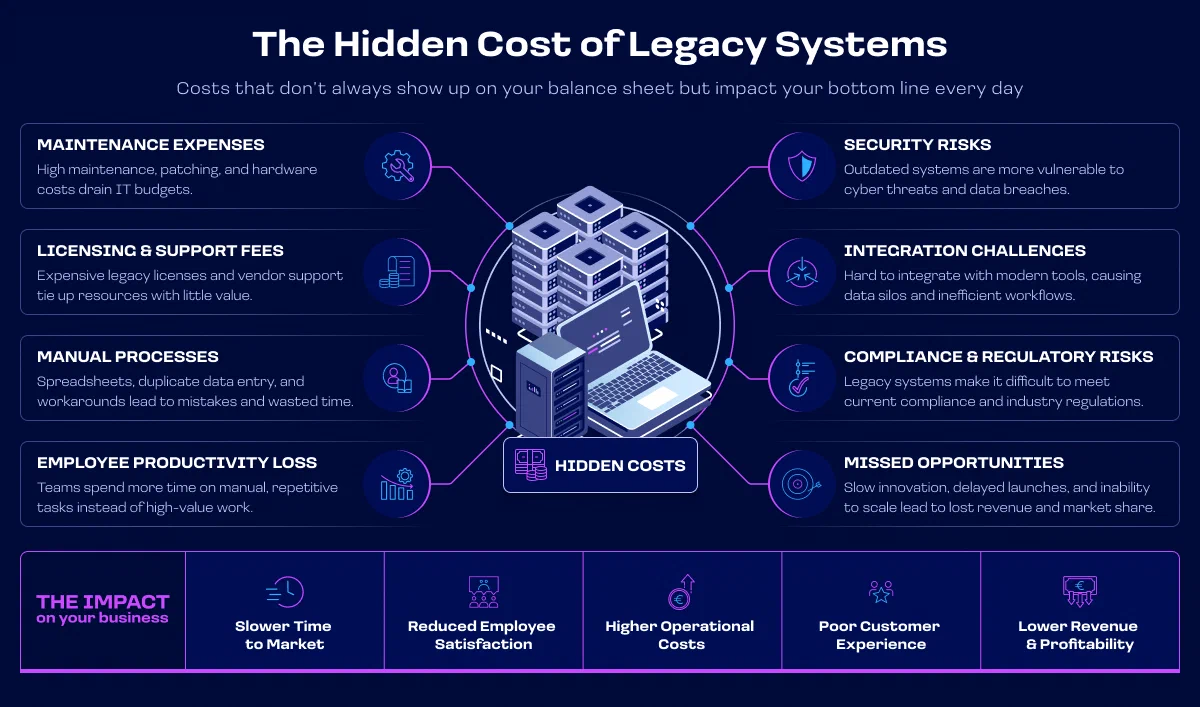
Most organizations focus on the obvious expenses of running legacy software. These include maintenance contracts, hardware upgrades, software licenses, and support costs. While these costs matter, they are only part of the picture.
The bigger challenge comes from hidden costs that grow over time. Employees spend hours transferring data between disconnected systems. IT teams dedicate resources to fixing recurring issues instead of supporting innovation. New features take months to deploy, limiting the business’s ability to respond to market changes.
As systems age, technical debt also increases. Older technologies often require specialized expertise that is becoming harder and more expensive to find. Security updates become more complicated, integrations require custom workarounds, and performance issues become more frequent.
These costs compound over time. A legacy platform that appears affordable today may be quietly reducing productivity, slowing growth, and increasing business risk. This is why many organizations eventually invest in legacy system modernization—not simply to upgrade technology, but to eliminate the hidden costs that prevent long-term growth.
| Cost Category | Examples | Business Impact |
|---|---|---|
| Direct Costs | Maintenance, licensing, hardware upgrades | Increased IT spending |
| Productivity Costs | Manual data entry, duplicate work, workarounds | Lower employee efficiency |
| Customer Costs | Slow systems, poor user experience | Lost customers and revenue |
| Security Costs | Vulnerabilities, compliance issues | Fines, breaches, reputational damage |
| Opportunity Costs | Delayed innovation, slow feature releases | Missed growth opportunities |
| Integration Costs | Custom connectors and middleware | Higher operational complexity |
7 Signs Your Legacy System Is Costing Your Business Money
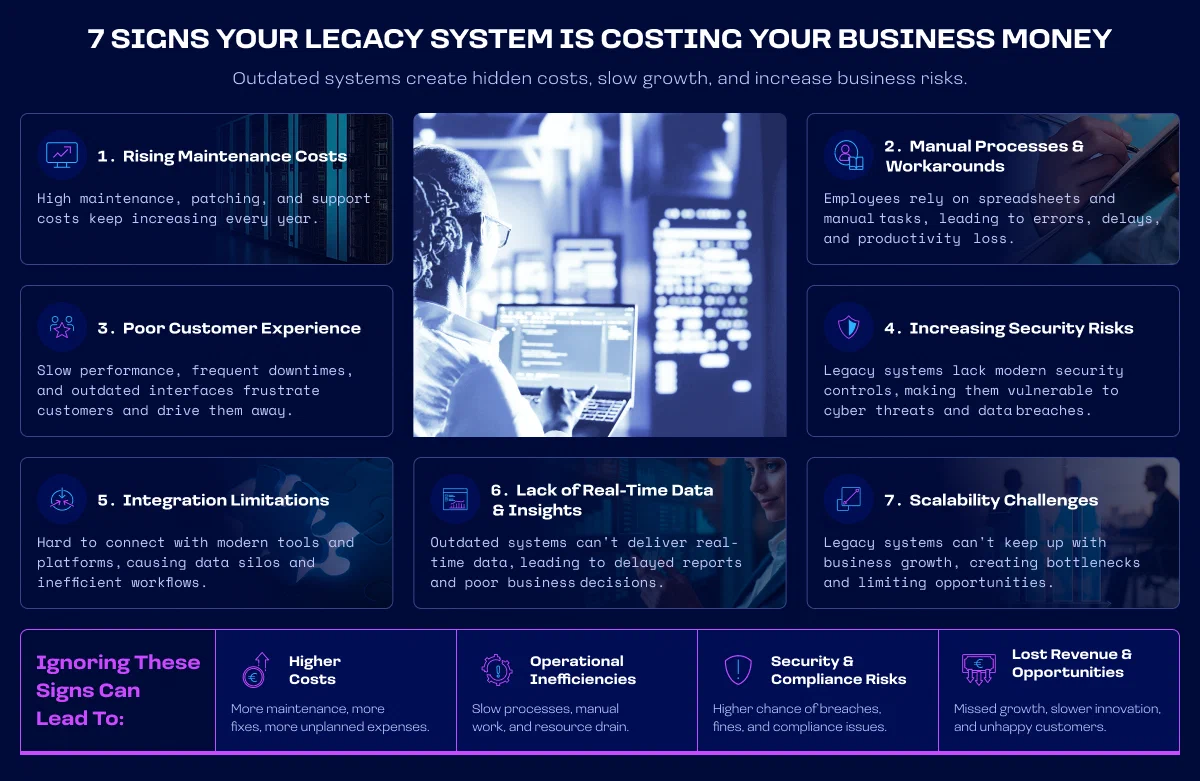
Sign #1: Maintenance Costs Keep Rising While Innovation Slows
One of the clearest warning signs is when your IT budget continues to grow, but the business sees little improvement. Instead of developing new features or improving customer experiences, your team spends most of its time maintaining existing systems.
Studies put the gap even higher: teams supporting legacy platforms can spend up to 2.5x more developer hours on upkeep compared to teams working on modern stacks, hours that translate directly into delayed roadmaps.
Legacy platforms often require constant fixes, patches, and workarounds. As the technology ages, even small updates become more complicated and expensive. When maintenance consumes most of your resources, innovation naturally slows down.
Sign #2: Employees Rely on Manual Workarounds and Spreadsheets
If employees regularly export data, update spreadsheets, or manually transfer information between systems, your software is creating unnecessary work.
These workarounds may seem minor individually, but they add up quickly. Teams spend valuable hours performing repetitive tasks that modern systems can automate. The result is lower productivity, increased errors, and higher operational costs.
When manual processes become part of everyday operations, it is often a sign that your systems can no longer support current business needs efficiently.
Sign #3: Customer Experience Is Suffering
Customers expect fast, seamless digital experiences. Unfortunately, legacy systems often struggle to meet those expectations.
Slow-loading applications, outdated interfaces, and inefficient processes can frustrate customers and reduce satisfaction. In some cases, customers may abandon purchases, switch providers, or leave negative reviews because the experience feels outdated.
What appears to be a customer service issue is often a technology issue underneath. Businesses that modernize legacy systems are typically better positioned to deliver the speed and convenience customers expect.
Sign #4: Security and Compliance Risks Are Increasing
Older systems are often more vulnerable to security threats because they rely on outdated technologies and unsupported software.
As regulations evolve, maintaining compliance also becomes more difficult. Organizations may struggle to meet modern security standards, audit requirements, or data protection regulations using legacy infrastructure.
The financial consequences can be significant. Beyond potential fines and recovery costs, security incidents can damage customer trust and harm your company’s reputation.
Sign #5: Your Systems Cannot Integrate with Modern Tools
Modern businesses depend on connected technology ecosystems. Customer relationship management platforms, analytics tools, cloud services, automation software, and AI-powered applications all need access to accurate data.
Legacy systems frequently lack the flexibility needed to support these integrations. As a result, businesses spend time and money building custom connectors or maintaining temporary solutions.
When integration projects consistently become expensive, time-consuming, or impossible, it may be time to evaluate legacy system modernization approaches that support greater flexibility.
Sign #6: Real-Time Data and Reporting Are Nearly Impossible
Business decisions are only as good as the data behind them. If your reporting depends on outdated information or manual data collection, decision-making becomes slower and less accurate.
Many legacy systems were not designed to process large amounts of data in real time. Reports may require manual preparation, overnight processing, or data exports from multiple sources.
Without real-time visibility, organizations struggle to identify trends, respond to customer needs, or capitalize on new opportunities. This can create a competitive disadvantage that grows over time.
Sign #7: Scaling the Business Feels More Difficult Than It Should
Growth should create opportunities, not operational headaches. If every new customer, product line, or business initiative places additional strain on your systems, scalability may be a concern.
Legacy applications are often built for business requirements that existed years ago. As organizations grow, these systems can become bottlenecks that limit expansion.
Businesses facing this challenge often explore legacy application migration or other legacy system modernization services to build a more flexible foundation. Modern platforms make it easier to support growth, integrate new technologies, and adapt to changing market demands without constant technical limitations.
| Warning Sign | Operational Impact | Revenue Impact |
|---|---|---|
| Rising maintenance costs | IT resources consumed by upkeep | Reduced innovation |
| Manual workarounds | Lower productivity | Higher operating costs |
| Poor customer experience | Increased frustration | Lost sales and retention |
| Security risks | Compliance challenges | Financial and reputational damage |
| Integration limitations | Slower workflows | Missed business opportunities |
| Lack of real-time data | Delayed decision-making | Slower growth |
| Scalability issues | Growth bottlenecks | Revenue constraints |
How Legacy Systems Impact Revenue Growth
The financial impact of legacy systems extends far beyond maintenance budgets. Many organizations underestimate how outdated technology affects productivity, customer retention, and long-term growth.
Employees often spend valuable time dealing with inefficient processes rather than focusing on high-value work. Manual data entry, duplicate tasks, and system limitations reduce overall productivity and increase operational expenses.
Customer experience is also affected. Slow applications, limited functionality, and service delays can push customers toward competitors that offer faster and more convenient solutions. Even small frustrations can influence purchasing decisions and customer loyalty.
Legacy systems also limit innovation. Businesses may struggle to launch new products, adopt emerging technologies, or respond quickly to market opportunities. As competitors move faster, the revenue gap can continue to widen.
Ultimately, the cost of maintaining outdated technology is not just what you spend—it is also what your business fails to earn.
Legacy System Modernization: What Are Your Options?
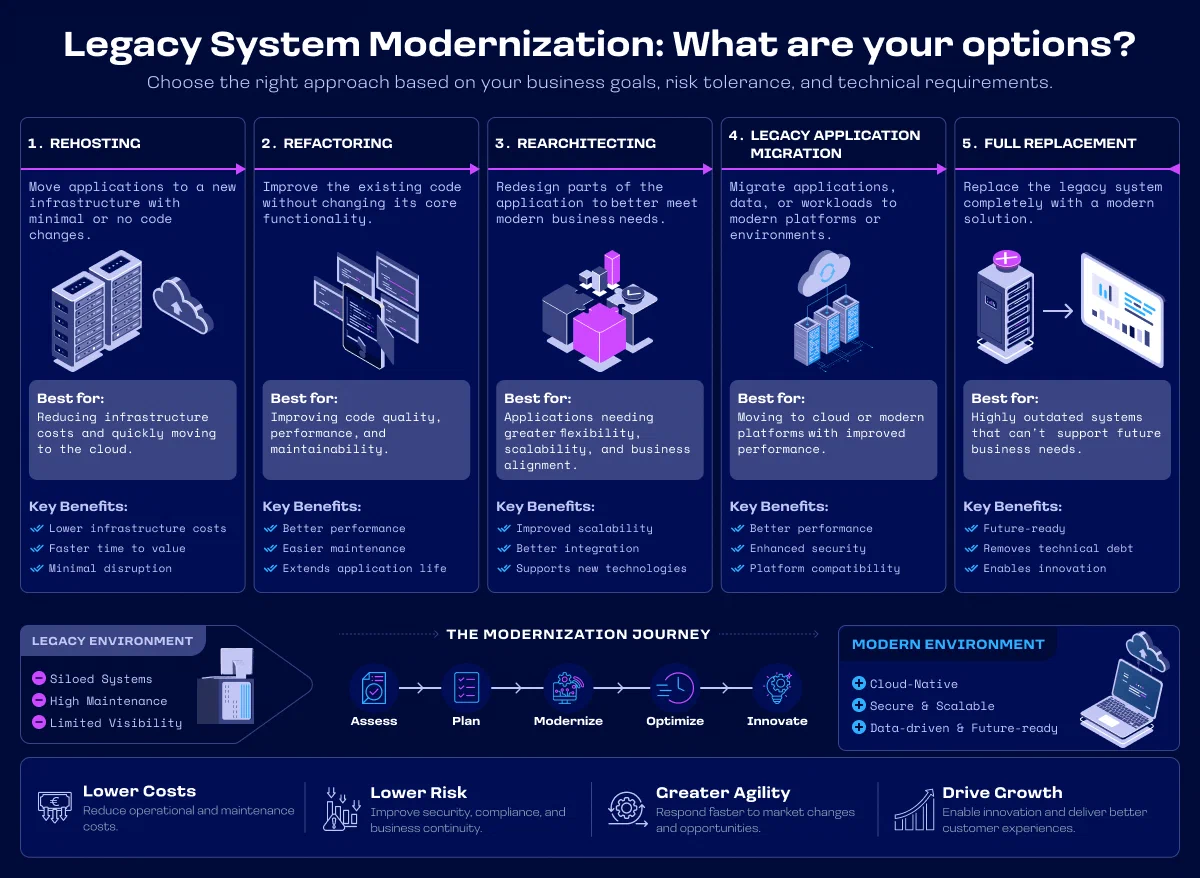
There is no single approach to legacy system modernization. The right strategy depends on your business goals, budget, and technical requirements.
Rehosting
Rehosting moves an application to a modern infrastructure environment, often the cloud, without making significant changes to the application itself. This approach can reduce infrastructure costs while minimizing disruption.
Refactoring
Refactoring improves the application’s codebase while preserving its core functionality. It helps increase performance, maintainability, and scalability without rebuilding everything from scratch.
Rearchitecting
Rearchitecting involves redesigning parts of the application to better support modern business requirements. This approach is often used when organizations need greater flexibility and integration capabilities.
Legacy Application Migration
Legacy application migration transfers applications, data, or workloads from older environments to modern platforms. This can improve performance, security, and compatibility with current technologies.
Full Replacement
In some cases, maintaining an outdated system no longer makes financial or operational sense. Replacing the application entirely may provide the greatest long-term value, especially when existing limitations prevent future growth.
How to Choose the Right Legacy System Modernization Approach
The best modernization strategy depends on your organization’s goals, budget, and risk tolerance. If the system still supports business operations effectively, an incremental approach such as rehosting or refactoring may be enough. However, if security issues, integration challenges, and scalability limitations are affecting growth, a more extensive modernization effort may be necessary.
Before making a decision, evaluate the system’s business value, maintenance costs, technical risks, and long-term viability. A clear assessment helps ensure that modernization investments align with business objectives.
When to Consider Legacy System Modernization Services
Many organizations lack the internal resources or specialized expertise required to modernize complex systems successfully.
Legacy system modernization services can help businesses assess risks, identify modernization opportunities, and implement solutions with minimal disruption. Experienced modernization partners also help reduce project risks and accelerate delivery timelines.
If maintenance costs continue to rise while business agility declines, seeking expert guidance may be the most cost-effective option.
Quick Legacy System Assessment Checklist
Review the following questions:
- Are maintenance costs increasing every year?
- Do employees rely on manual workarounds?
- Are integrations with modern tools difficult?
- Is system performance affecting customers?
- Are security or compliance concerns growing?
- Is growth creating technology bottlenecks?
If you answered “yes” to several of these questions, your organization may benefit from legacy system modernization.
Conclusion
Legacy systems often appear manageable because their costs are spread across multiple departments and processes. However, rising maintenance expenses, manual workflows, security risks, poor integration capabilities, and limited scalability can significantly affect profitability over time.
Recognizing these warning signs early allows organizations to take proactive steps before technology becomes a major obstacle to growth. Whether through refactoring, rearchitecting, or legacy application migration, modernization can help reduce costs, improve efficiency, and create a stronger foundation for future innovation. If you are ready to take the next step, get in touch with a modernization expert to discuss your options.
Frequently Asked Questions
What is legacy system modernization?
Legacy system modernization is the process of updating outdated software, infrastructure, or applications to improve performance, security, scalability, and business agility.
What are the biggest legacy system costs?
Common costs include maintenance, technical debt, security risks, productivity losses, integration challenges, and missed business opportunities.
How do I know if my system is outdated?
Frequent downtime, rising maintenance costs, manual processes, security concerns, and poor integration capabilities are common warning signs.
What are common legacy system modernization approaches?
Popular approaches include rehosting, refactoring, rearchitecting, replacing applications, and legacy application migration.
What is legacy application migration?
Legacy application migration involves moving applications, workloads, or data from older environments to modern platforms or cloud infrastructure.
Can legacy systems be modernized gradually?
Yes. Many organizations modernize systems incrementally to reduce risk, control costs, and minimize business disruption.
How long does modernization take?
Project timelines vary based on complexity. Smaller modernization initiatives may take months, while larger transformations can take significantly longer.
When should a company replace a legacy system completely?
Complete replacement is often appropriate when maintenance costs, security risks, and business limitations outweigh the benefits of keeping the existing system.

Alexander Nickol
Software Architect & Developer
I'm passionated about programming languages and software architecture. I can offer a great versatility of skills, entrepreneurial behavior and solution-oriented thinking in areas such as Software Architecture, Software Design and Software Development in Rust and Java.
Related Articles
The Strangler Fig Pattern: Modernizing Legacy Systems Step-by-Step with Rust
Learn how the Strangler Fig pattern replaces legacy systems step-by-step with microservices, reducing the risks of complex system migrations.
Migrating C++ to Rust: Incremental Modernization Without a Full Rewrite
Learn how organizations incrementally modernize legacy C++ systems with Rust to limit risks and avoid the high costs of a complete rewrite.