Migrating C++ to Rust: Incremental Modernization Without a Full Rewrite
Learn how organizations incrementally modernize legacy C++ systems with Rust to limit risks and avoid the high costs of a complete rewrite.
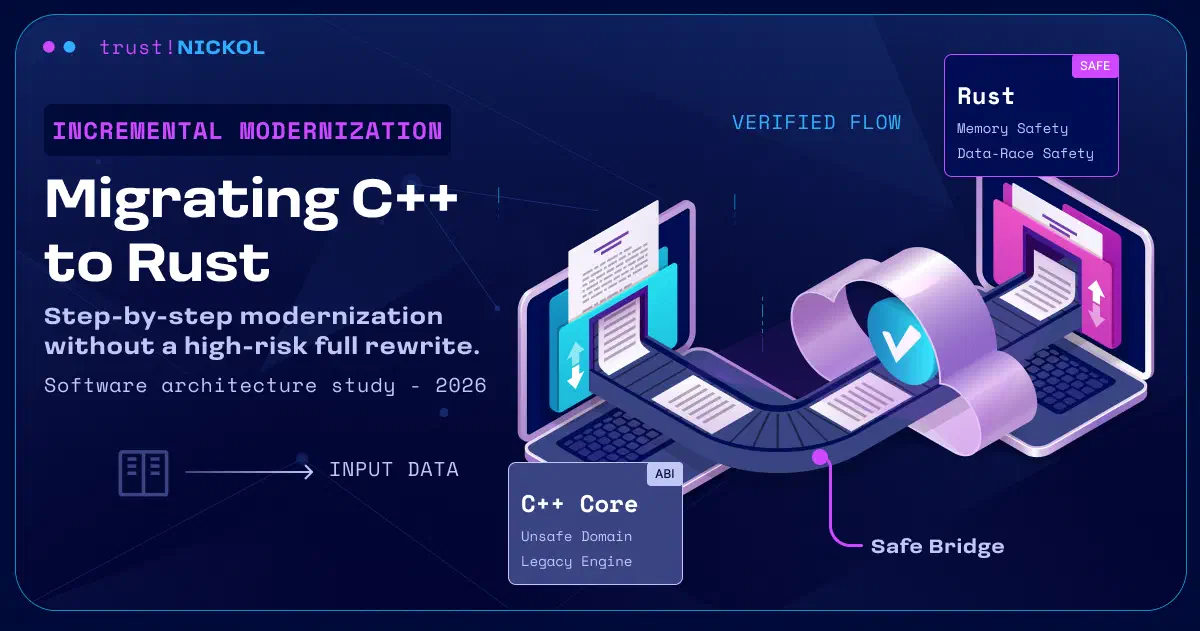
Table of Contents
An established, organic C++ system can rarely be paused for months to be rewritten and replaced in one fell swoop. Too many products, processes, and customers rely on its continuous operation. At the same time, legacy code often drives up the costs of debugging, security audits, and changes. Rust offers an escape route, but not by launching another high-risk mega-project. The superior approach is a controlled coexistence: C++ remains where it performs reliably today, while Rust selectively takes over new or particularly high-risk components.
Migrating C++ to Rust is therefore less about bulk code translation and more about making sound architectural decisions. This article demonstrates which modules are best suited as entry points, how Rust and C++ interoperate technically, and how to turn a pilot project into a successful, step-by-step modernization program.
Why a Full Rewrite Is Usually the Wrong Starting Point
On paper, a complete rewrite looks pristine. The legacy system is swapped out for a clean codebase, technical debt disappears, and the team gets to use modern tools. In practice, however, a new system does not start from scratch. It must accurately replicate years of accumulated business logic, edge cases, performance characteristics, and third-party integrations. While some of this knowledge is documented, much of it is locked away inside the behavior of the existing running code.
This introduces three critical risks simultaneously: First, the engineering team delivers very little visible business value over a long period because the new platform is simply playing catch-up to existing functionality. Second, the legacy and modern systems drift apart as the live product continues to be actively developed. Third, the actual proof of concept is delivered too late: only at the final cutover does it become clear whether the system meets the required functionality, load capacity, and operational standards.
An incremental migration mitigates these risks. It treats Rust not as an end in itself, but as a surgical tool for clearly defined problems. A single module is selected, integrated via a narrow interface, and evaluated against the existing system. If the approach fails, the rollback path is small and manageable. If it succeeds, the pilot delivers concrete technical data to inform the next architectural decision.
This closely resembles the Strangler Fig Application pattern described by Martin Fowler: new features or replacement components grow around the perimeter of the legacy system and gradually take over its duties. The key difference in a C++-to-Rust migration lies in the execution: the new boundary often runs directly inside a single native process. As a result, the Application Binary Interface (ABI), memory ownership, and error handling are just as critical as the high-level business boundaries of the module.
Which C++ Modules Are Best Suited as Entry Points?
The ideal first candidate should be significant enough to yield valuable lessons but not so mission-critical that a single error threatens entire business operations. A good pilot component possesses clear responsibilities, minimal dependencies, and measurable inputs and outputs. Classic examples include parsers for untrusted data, file converters, protocol adapters, compression engines, background utilities, or entirely new features that do not yet exist in the legacy C++ codebase.
Four key criteria can help guide your selection:
- Security Risk Profile: Does the module process external or malformed inputs? Does it contain heavy manual memory management, complex object lifetimes, or multi-threaded code? If so, Rust’s compile-time safety can deliver massive dividends.
- Coupling Density: Can the component be interfaced through a few stable functions? A narrow interface reduces the number of custom types, states, and error scenarios that must be translated across the language barrier.
- Measurability: Can execution time, memory footprint, error rates, and output correctness be verified automatically? Without clearly defined metrics, the evaluation of your pilot remains a matter of opinion.
- Rollback Capability: Can the legacy module remain available in parallel during deployment? Feature flags or an abstract adapter layer allow for a controlled, risk-free rollout.
Generally unsuited are central domain entities that are passed through almost every layer of the system, or tightly coupled modules with many implicit side effects. Starting there forces you to untangle a major portion of the architecture immediately. While this might be necessary eventually, it is a poor candidate for your team’s first Rust experiment.
Adding new native features is also an excellent starting point. Google has followed this exact strategy with Android for years: new native components are preferred to be built in memory-safe languages rather than rewriting the entire legacy C++ system. In the 2022 Android Security Report, Google explicitly describes this approach as far more practical than broad-scale code conversion. While Android’s metrics do not translate directly to every company, they prove that gradual modernization is highly viable even in massive native codebases.
In practice, we observe three reliable integration patterns:
- Greenfield Pattern, a brand-new component is written in Rust and integrated with the legacy C++ codebase.
- Replacement Pattern, Rust replaces an existing C++ module behind the same domain interface.
- Protective Shield Pattern, Rust sits in front of a rigid, legacy C++ core, handling input validation, parsing, or rate-limiting.
The Greenfield pattern typically requires the lowest upfront effort. The Replacement pattern yields the cleanest before-and-after comparison. A Protective Shield can quickly neutralize immediate security risks but leaves the underlying legacy technical debt intact. Your choice should always align with the primary goals of the pilot, rather than simply opting for where Rust is easiest to plug in.
How Rust and C++ Interoperate Reliably
The most critical architectural decision lies neither in Rust nor in C++ itself, but on the boundary between them. The wider this interface is, the more permanent complexity is introduced into the system. Therefore, a modernizing module should never attempt to mirror complex internal object graphs across the boundary. It is far better to expose a small set of domain operations using simple data types and clean boundaries for memory ownership and error handling.
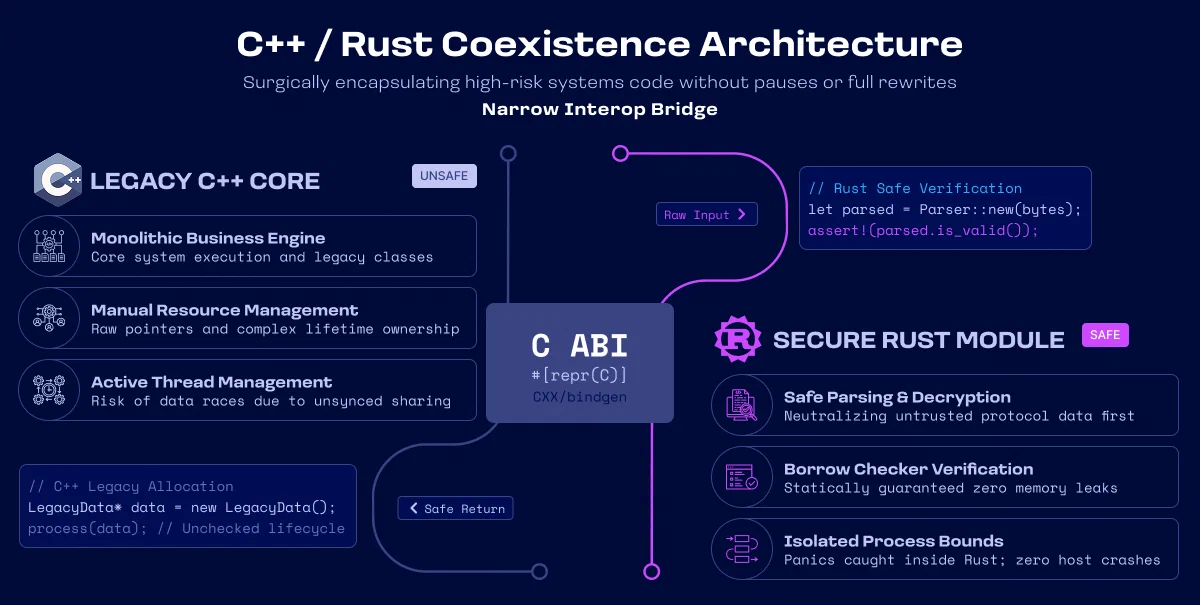
The lowest common denominator is typically a C-compatible Application Binary Interface (ABI). Rust exposes functions via extern "C", and shared data structures are given a defined C representation with #[repr(C)] where necessary. On the C++ side, a thin wrapper class translates this low-level C interface into idiomatic C++ constructs. The Foreign Function Interface (FFI) documentation in the Rustonomicon outlines the core rules of this interop and delivers a clear warning: the compiler cannot verify the correctness of a foreign interface on its own.
For larger, more sophisticated boundaries, several specialized tools can automate the process:
- CXX generates a highly typed bridge between Rust and C++. It natively supports selected common types and verifies key aspects of the interop contract at compile time. This strict, deliberate limitation is highly beneficial because it actively prevents interface bloat.
- bindgen automatically generates Rust bindings from existing C or C++ headers, making it easy to call existing libraries from Rust.
- cbindgen works in the opposite direction, parsing Rust source files to generate C or C++ header files for a Rust library with a C-compatible API.
- Corrosion seamlessly integrates Cargo packages directly into existing CMake builds, ensuring you do not have to overhaul your current build infrastructure on day one.
Regardless of the tooling, four fundamental rules must be explicitly defined and documented: Who owns a given memory buffer? How long do pointers and references remain valid? How are errors communicated? And which threads are allowed to execute which functions? C++ exceptions must never cross the language boundary. Similarly, Rust panics must be caught inside the Rust layer or managed via a robust process recovery strategy. At the FFI boundary, simple status codes, error structs, or explicit return structures are far more resilient.
Simplicity of data models is equally critical. Flat structs, raw byte buffers, length-prefixed strings, and opaque handles are significantly easier to safeguard than complex inheritance hierarchies. While this might feel less ‘object-oriented,’ it shields both languages from dangerous implicit assumptions. Memory safety does not automatically expand across the entire application just because Rust is introduced: unsafe FFI blocks, invalid pointers supplied by C++, or incorrect lifetime modeling can still compromise the system. Consequently, the interop layer must be reviewed, tested, and documented with the same rigor as an external, public API.
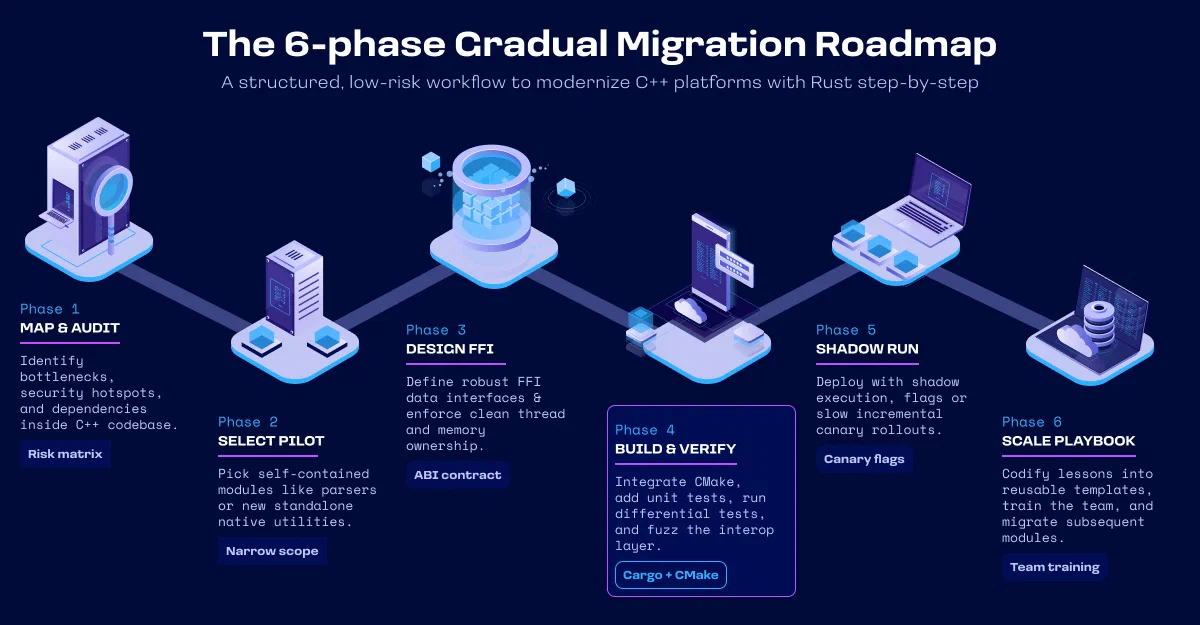
Migrating C++ to Rust: An Incremental Roadmap in Six Steps
1. Map Your System and Define Clear Goals
Do not start by listing individual source files; start by building an architectural map of your entire system. Identify which components are responsible for frequent production bugs, where development velocity slows down, and which modules process untrusted network data. Map out which interfaces are already stable. Correlate these technical data points with operational business impacts, such as application downtime, support workloads, or delayed release cycles.
Next, establish a concrete, measurable goal. ‘Using more Rust’ is not a metric. Instead, set objectives like: eliminating memory bugs in the network parser, cutting down development cycle times for a protocol adapter by 50%, or implementing a new feature with zero C++ legacy dependencies. This specific focus determines both the selection of your pilot and how you will measure its success.
2. Select a Well-Bounded Pilot Project
Your pilot project should allow your team to complete a full development and deployment loop (building, integrating, testing, deploying, and monitoring) within a few weeks. Before writing code, explicitly define your success criteria. These should include functional equivalence for a core reference dataset, a maximum latency budget, zero new crash reports, and a strict limit on the time allowed for integration.
Always retain the legacy C++ implementation during the pilot. Design an adapter layer that can route calls to either the C++ or the Rust backend. For deterministic operations, consider running a shadow deployment: both the legacy and modern code execute simultaneously with the same live inputs, but only the C++ output is returned to production. Any discrepancies in results are logged, flagged, and investigated.
3. Design the Language Boundary
Before writing a single line of Rust code, establish the interop contract. Outline the exported functions, data structures, memory ownership models, thread-safety assumptions, and error reporting mechanisms. Keep the number of shared data types to an absolute minimum. A clean boundary encapsulates an entire domain operation (such as ‘validate network message’) rather than exposing fine-grained utility functions from deep within the module.
Determine which side controls the API design. For a new Rust component, exposing a thin, C-compatible facade allows the internal Rust implementation to evolve independently. Conversely, if you force the Rust code to directly replicate a large, historical C++ API, you will import all of its legacy architectural complexity. While you will have successfully written Rust code, you will have failed to modernize your software architecture.
4. Integrate Build, Testing, and Operations
Modernization projects rarely fail because of a broken function call; they fail due to brittle build systems, mismatched toolchains, packaging conflicts, or a lack of production visibility. You must integrate Cargo into your continuous integration (CI) pipeline and your legacy build system (e.g., CMake). Fix compiler versions, lock target platforms, audit dependencies, and ensure that all build artifacts are fully reproducible.
Your testing strategy must span multiple levels: Rust unit tests verify internal correctness; contract tests validate FFI constraints; and differential testing runs both legacy C++ and new Rust engines with the same test suites to ensure identical results. Use fuzzing tools for binary protocol adapters and parsers. Finally, run comprehensive load tests to monitor not just average latency, but P99 tail latency and peak memory usage.
Observability must bridge the language divide seamlessly. Ensure that logs share unified correlation IDs, metrics employ the same domain definitions, and crash-reporting tools can parse symbols from both toolchains. Otherwise, your operations team will be left with a major blind spot right at the FFI boundary.
5. Roll Out Incrementally and Measure Impact
Once your tests pass, avoid a total system switch. Activate the Rust module first in internal environments, followed by a tiny slice of production traffic. Use feature flags, specific tenant groups, or isolated network paths to control the rollout. For every deployment tier, establish clear rollback triggers and ensure that the reverse migration path is tested and fully operational.
Look beyond raw technical performance during your evaluation. Measure development cycle times, code review overhead, regression rates, production incidents, and the time-to-diagnosis for cross-language errors. A 2025 Google Security Report highlighted that incorporating Rust into Android yielded a massive drop in memory safety vulnerabilities and fewer rollbacks. These metrics are a powerful testament to Rust’s benefits, but they are not automatic guarantees. Your local telemetry must drive your decisions.
6. Scale the Pilot Into a Structured Modernization Program
Following a successful pilot, do not immediately rush into migrating random modules. First, document your architectural findings: proven FFI patterns, build toolchain integrations, code review guidelines, testing frameworks, and operational KPIs. This documentation forms your repeatable migration playbook. Creating a small internal starter project can help introduce other team members to building, connecting, and debugging a Rust library within your environment.
From there, prioritize subsequent components using the same strict criteria. Some legacy C++ modules will be replaced, while others should be deliberately left untouched. Only when all live calls have been redirected to the Rust layer and the monitoring phase is complete should you delete the old C++ code. This prevents the emergence of a permanent dual system without requiring a risky, single-day cutover.
Typical Migration Risks and Practical Countermeasures
The first major risk is FFI boundary bloat. Attempting to map every C++ class to a Rust equivalent increases architectural coupling and balloons your test suite. The countermeasure is to enforce a clean domain facade exposing only high-level operations.
The second risk is ambiguous memory ownership. Every shared buffer must have an ironclad, documented rule governing allocation, modification, and deallocation. Rigorous API documentation and running automated tests with memory sanitizers (such as ASan or MSan) are vital, even when writing safe Rust.
The third risk is underestimating the build toolchain. Rust introduces Cargo, an independent dependency model, and new compiled output formats. Setting up a basic CI pipeline prototype early prevents a scenario where the pilot builds successfully on a developer’s local laptop but fails during automated release packaging or when targeting specific deployment environments.
The fourth risk is the creation of knowledge silos. If only one engineer understands the FFI boundary, you have simply traded technical debt for a single point of failure. Prevent this by using pair programming, conducting joint code reviews, and publishing short architectural decision records (ADRs). Your team does not need to become elite Rust engineers overnight; they simply need clear, stable standards for the specific modules in scope.
Finally, beware of ‘architecture creep.’ A migration should surgically address technical debt, but it should not be used as an excuse to rewrite your entire database schema, communications protocol, and deployment strategy simultaneously. The more variables you alter during a pilot, the harder it becomes to isolate and evaluate its results.
How to Measure Modernization Success
Success is not measured by the number of active lines of Rust code. Meaningful key performance indicators (KPIs) must link technical outcomes to business delivery:
- Production stability: reduction in crash rates, memory leaks, and security vulnerabilities inside the modernized module.
- Technical performance: stable P50, P95, and P99 latencies, along with predictable peak memory consumption.
- Delivery velocity: the average time required to develop, review, and ship a comparable feature update.
- Operational risk: the count and root cause of deployment rollbacks or emergency hotfixes.
- Diagnostics efficiency: the time needed to locate and diagnose errors across the language boundary.
- Adoption coverage: the percentage of production traffic reliably routed through the new Rust module.
An incremental migration is not always the most economical decision. A stable, legacy C++ component that requires infrequent changes and carries low security exposure may be best left untouched. Similarly, if your target embedded platform lacks mature toolchain support, if legacy software certifications make compliance prohibitively expensive, or if your organization cannot sustain the long-term maintenance of the Rust toolchain, sticking with C++ is the pragmatic path.
Ultimately, the question is not ‘Should we build our entire product in C++ or Rust?’ The question is: ‘For this specific module, what concrete technical risk or delivery bottleneck are we trying to resolve, and is Rust the most cost-effective lever to achieve it?’
For deeper decision-making criteria, explore our article on Why Companies Are Choosing Rust Over C++ in 2026. For a broader analysis of the business impacts of outdated code, read The Hidden Cost of Legacy Systems Most Businesses Overlook.
Conclusion: Migration as a Controlled Architectural Strategy
Upgrading C++ systems to Rust does not require a high-risk, multi-month rewrite. The only reliable path begins with a tightly bounded module, a slim and heavily verified interop layer, and concrete performance metrics established prior to deployment. C++ and Rust can comfortably coexist for years, provided that ownership, toolchain integrations, and rollback playbooks are clearly defined.
If you are evaluating which parts of your system are the best candidates for a Rust pilot, trust!NICKOL can perform a comprehensive code audit of your current software architecture and design a prioritized, low-risk migration roadmap. This transforms vague technical interest into a practical, data-driven business strategy.
FAQ: Incremental C++ to Rust Migration
Does a C++ application need to be fully rewritten to use Rust?
No. Rust libraries can be compiled and integrated directly into existing C++ applications using a C-compatible ABI or higher-level bridge tooling like CXX. For the vast majority of enterprises, it is far more sensible to migrate selective, high-risk components step-by-step while maintaining and operating their stable C++ legacy codebase.
Can Rust and C++ run within the same process?
Yes. Both languages can run side-by-side in the same operating system process. This requires a well-defined Foreign Function Interface (FFI) contract, compatible binary data layouts, and clear rules governing memory ownership, object lifespans, thread execution, and error handling. The interop boundary should be designed as narrow as possible.
Which module should we migrate to Rust first?
The best candidate is a self-contained module with predictable inputs and outputs, minimal external dependencies, and clear business value. Network parsers, file format converters, protocol adapters, or newly requested native features are typically far safer and more rewarding pilots than deep, central domain models.
Does Rust automatically guarantee better safety and performance?
Rust guarantees memory and concurrency safety exclusively within its safe language subsets. Unsafe FFI blocks, raw pointers passed from C++, and logic errors can still introduce bugs. Similarly, high performance is not automatic; safety patterns, memory layouts, and execution flow must be benchmarked and optimized for your specific system requirements.
How long does an incremental C++ to Rust migration take?
This depends heavily on system size, coupling density, build target platforms, and testing requirements. A well-bounded pilot project can typically deliver production-ready findings within a few weeks. Modernizing a large, enterprise-scale native system is a multi-year strategy where C++ and Rust are intentionally operated in parallel.
Sources and Further Reading
- Google Security Blog: Memory Safe Languages in Android 13
- Google Security Blog: Rust in Android: move fast and fix things
- Rustonomicon: Foreign Function Interface
- CXX: Safe interop between Rust and C++
- rust-bindgen User Guide
- cbindgen on GitHub
- Corrosion: Rust and CMake Integration
- Martin Fowler: Strangler Fig Application

Alexander Nickol
Software Architect & Developer
I'm passionated about programming languages and software architecture. I can offer a great versatility of skills, entrepreneurial behavior and solution-oriented thinking in areas such as Software Architecture, Software Design and Software Development in Rust and Java.
Related Articles
The Strangler Fig Pattern: Modernizing Legacy Systems Step-by-Step with Rust
Learn how the Strangler Fig pattern replaces legacy systems step-by-step with microservices, reducing the risks of complex system migrations.
Performance Engineering on Solana in 2026: Optimizing Compute, Costs, and Latency
Optimize Solana compute units, priority fees, and end-to-end latency in 2026 with practical guidance for reliable, production-grade applications.
Rust for Backend Development: Pros, Cons, and Use Cases
Discover the pros, cons, frameworks, and real-world use cases of Rust backend development. Learn when Rust is the right choice for scalable, secure, and high-performance backend systems.