Performance Engineering on Solana in 2026: Optimizing Compute, Costs, and Latency
Optimize Solana compute units, priority fees, and end-to-end latency in 2026 with practical guidance for reliable, production-grade applications.
Table of Contents
Solana was designed for high-performance applications. But building on a fast blockchain does not automatically make an application fast. A transaction can execute correctly and still be poorly engineered: it can request far more compute than it needs, pay an unnecessarily high priority fee, wait too long before reaching a leader, collide with heavily contested accounts, or appear to disappear because retry and confirmation logic is not robust enough.
That distinction matters as Solana applications move beyond prototypes into payments, DeFi, trading systems, gaming, DePIN, tokenization, and other production workloads.
In 2026, performance engineering on Solana should therefore be treated as a software architecture discipline, not as a last-minute optimization task.
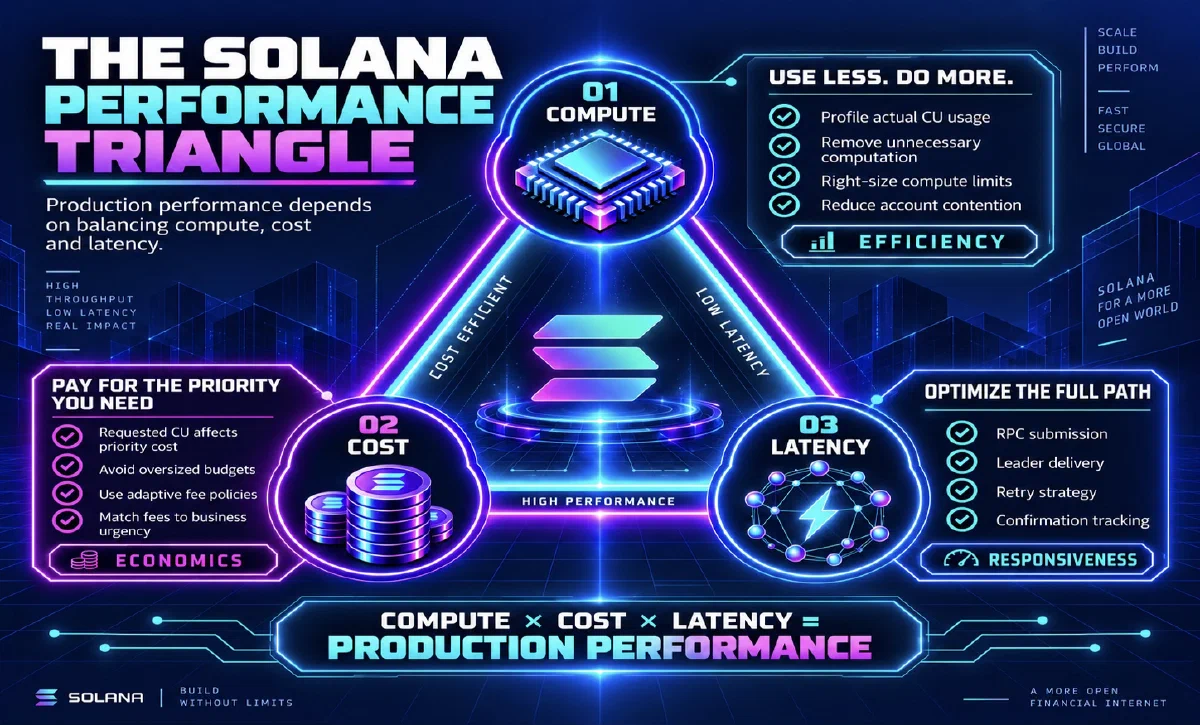
The objective is not simply to make one instruction cheaper. It is to optimize three interconnected dimensions: compute efficiency, transaction economics, and end-to-end latency. When these are engineered together, applications become cheaper to operate, more predictable under load, and considerably better from the user’s perspective.
Why Solana Performance Engineering Matters in 2026
Solana’s architecture gives developers an unusually large performance envelope, but applications still compete for finite execution, networking, and scheduling resources.
Every Solana transaction pays a fee in SOL. The current fee model combines a base fee with an optional prioritization fee that can improve the likelihood that a transaction is scheduled ahead of competing transactions. Solana currently documents a base fee of 5,000 lamports per signature. Solana Fees
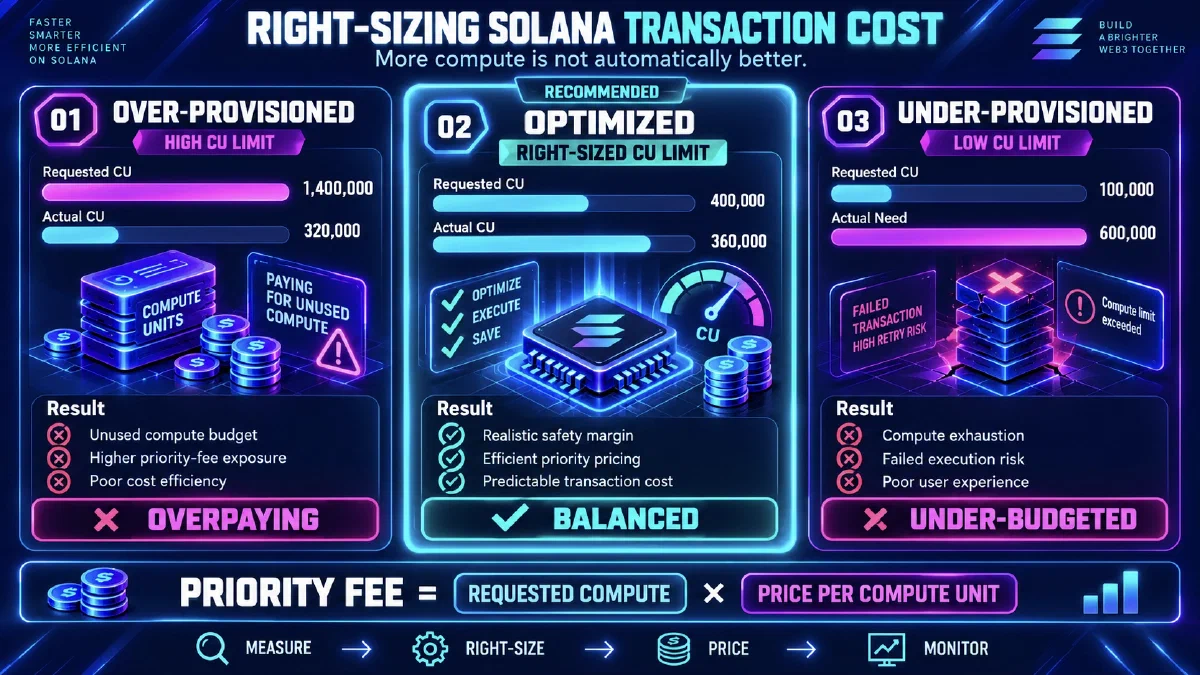
Compute directly affects transaction economics. For legacy and v0 transactions, Solana documents a default allocation of 200,000 compute units per non-builtin instruction and a maximum of 1.4 million compute units per transaction. More importantly, the priority fee is calculated from the requested compute budget rather than the amount ultimately consumed. Compute Budget
Meanwhile, the network itself continues to evolve. The Solana Foundation’s 2026 XDP update reports supermajority adoption of kernel-bypass networking and links those propagation improvements to the rollout of 100 million compute-unit blocks on mainnet in July 2026. XDP on Solana
More network capacity is valuable, but it does not replace application-level engineering. A poorly designed transaction pipeline can still waste compute, overpay for priority, create account contention, or handle retries incorrectly on a faster network.
Start With Compute Units, Not Guesswork
Compute units are Solana’s way of accounting for the computational resources required to execute a transaction. The most basic optimization mistake is setting compute limits by intuition.
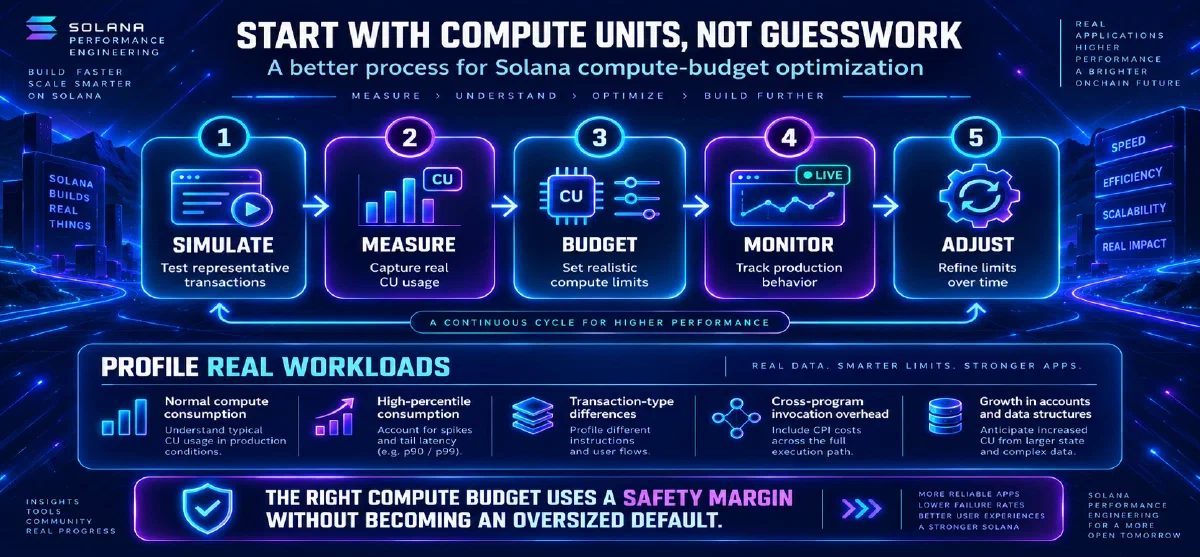
Solana’s current Compute Budget guidance recommends simulating the transaction, measuring actual CU consumption, and adding a modest safety margin rather than relying on oversized defaults. The documentation specifically illustrates a 10% safety margin after simulation. Solana Compute Budget
For production systems, this means profiling representative workloads rather than a single ideal transaction. Useful profiles include:
- Normal compute consumption
- High-percentile consumption
- Differences between transaction types
- Compute introduced by cross-program invocations
- How usage changes as accounts or data structures grow
The correct compute budget should provide enough safety margin for realistic execution variability without becoming an oversized default applied everywhere.
Reduce Unnecessary Work On-Chain
Compute optimization can also expose architectural problems.
Repeated serialization, unnecessary logging, expensive data structures, redundant account checks, excessive cross-program invocations, and avoidable state transformations all consume resources.
A few hundred compute units may appear irrelevant during development. Across a high-volume application, they become part of the economics of the platform.
That is why mature teams do not treat CU optimization as isolated smart-contract tuning. They ask a broader question: is this computation happening in the right part of the architecture?
Some work belongs on-chain because it must be deterministic and trustless. Other work can be prepared, aggregated, cached, indexed, or validated elsewhere. Good performance engineering identifies that boundary.
Design for Parallelism and Watch Account Contention
Solana’s execution model can process independent transactions in parallel because transactions declare the accounts they intend to access. That is a major architectural advantage, but it comes with an important consequence: parallel execution is only useful when workloads are actually parallelizable.
Transactions that require conflicting write access cannot simply execute simultaneously.
Academic analysis of historical blockchain workloads describes Solana as using a read-write-aware execution model in which state access is declared in advance. The same research shows that transaction conflicts can limit exploitable concurrency. Transaction-conflict study
For application architects, this turns account design into a performance question. Consider a system where thousands of otherwise independent actions all require writing to one shared account. The individual program may be efficient; the architecture is not.
- Which accounts become hot?
- Which writes can be separated?
- Can state be partitioned?
- Does one global structure unnecessarily serialize activity that could otherwise execute concurrently?
This becomes especially important for high-volume DeFi, marketplaces, trading infrastructure, games, and other systems where bursts of transactions target the same state.
Optimize Priority Fees Instead of Hard-Coding Them
Low transaction costs are one of Solana’s attractions, but “low cost” should not be confused with “no fee strategy.” A production system needs to decide how much a successful transaction is worth at that moment.
For legacy and v0 transactions, the prioritization fee is derived from the requested compute-unit limit and the selected compute-unit price. In simplified terms: requested compute × price per compute unit. The exact fee calculation converts micro-lamports to lamports and rounds up. Fee Structure
This creates two variables to optimize together: the Compute Unit Limit, which expresses how much computation the transaction may use, and the Compute Unit Price, which expresses how much priority is being purchased.
Optimizing only one is incomplete.
Why Static Priority Fees Are Weak Architecture
Imagine applying the same priority fee to every application action. During low demand, you may consistently overpay. During congestion, the same fee may not provide the reliability required for time-sensitive transactions. Different business operations also do not have the same urgency.
A user submitting a time-sensitive trade may value rapid execution very differently from an application recording non-urgent background state. A better architecture classifies transactions by business criticality.
| Transaction Type | Latency Sensitivity | Suggested Strategy |
|---|---|---|
| Background maintenance | Low | Conservative priority |
| Standard user action | Medium | Adaptive priority |
| Payment / important state change | High | Stronger dynamic priority |
| Trading / liquidation / time-sensitive execution | Very high | Aggressive latency-aware strategy |
The exact values should come from current network conditions and transaction urgency rather than a permanent constant copied into the codebase. That is a broader software architecture lesson: infrastructure policy should reflect business intent.
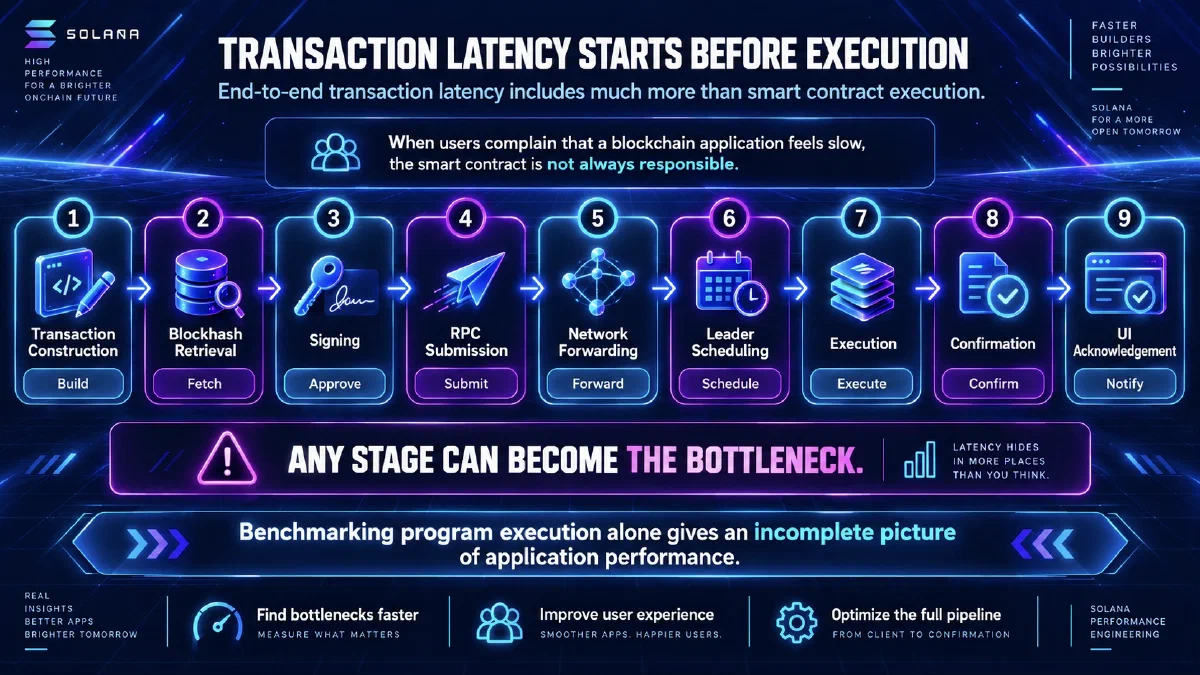
Transaction Latency Starts Before Execution
When users complain that a blockchain application feels slow, the smart contract is not always responsible.
Any stage can become the bottleneck. This is why benchmarking program execution alone gives an incomplete picture of application performance.
RPC Architecture Matters
Applications frequently depend on an RPC provider to submit and observe transactions.
Solana’s retry documentation explains that transactions may be dropped before they are included in a block. During congestion, generic RPC rebroadcasting may not be sufficient for every application, so latency-sensitive systems may need application-specific rebroadcast logic. Retrying Transactions
RPC pools introduce another subtle issue. If one backend is ahead of another, a recent blockhash fetched from the advanced backend may not yet be recognized by the backend that receives the transaction, causing the transaction to be dropped.
That is not a smart-contract problem. It is a distributed-systems problem. Solana development therefore benefits from the same architectural thinking applied to high-performance backend systems.
Engineer Retry Logic as Part of the Transaction Lifecycle
A successful sendTransaction response does not mean the transaction has executed or finalized. It only establishes that the RPC endpoint accepted the submitted transaction for forwarding. Production software should understand the complete transaction lifecycle.
Solana transactions based on a recent blockhash have a limited validity window. The current confirmation documentation explains that validators accept blockhashes within the most recent 151 entries, which typically corresponds to roughly 60–90 seconds depending on slot duration. Transaction Confirmation & Expiration
That gives applications a bounded retry window. A robust transaction manager should know:
- The transaction signature
- Its last valid block height
- Whether it has landed
- Whether it is still valid
- When rebroadcasting makes sense
- When a new transaction must be constructed
Retries should be controlled rather than simply flooding endpoints. Solana’s production guidance recommends explicit expiration tracking, controlled retries, and backoff behavior. Production Readiness
What About skipPreflight?
There is no universal answer.
Solana’s current production guidance notes that skipPreflight: true can reduce submission latency when a transaction has already been validated. During development, keeping preflight enabled remains useful because simulation can expose errors before submission.
That is the kind of trade-off performance engineering is really about. The useful question is not simply “Which option is faster?” but “Which reliability/latency trade-off is appropriate for this workload?”
Think Beyond RPC: Transaction Delivery Is Part of the Architecture
Application developers also need to understand what happens after a transaction leaves their infrastructure.
Stake-weighted Quality of Service allows Solana leaders to identify and prioritize transactions proxied through staked validators as an additional sybil-resistance mechanism. For latency-sensitive applications, this is another reminder that transaction delivery depends on more than an HTTP request to an RPC endpoint. Stake-weighted QoS
Depending on the workload, the architecture may need to consider:
- RPC quality and health
- Geographical placement
- Connection management
- Transaction routing
- Validator connectivity
- Congestion-aware fee estimation
- Retry behavior
- Observability
This is particularly relevant for products where a difference of hundreds of milliseconds materially affects the user or the business.
Measure What Users Experience
Performance engineering fails when teams optimize only what is easy to measure. Program CU consumption is useful. RPC response time is useful. But neither represents the entire user experience.
For production Solana applications, useful metrics can include:
Compute
- CU consumed per transaction type
- CU requested vs. consumed
- Failed execution due to compute limits
Fees
- Priority fee per successful transaction
- Fee distribution by transaction class
- Cost per completed business action
Submission
- Submission success rate
- Rebroadcast count
- Blockhash-expiration rate
- Dropped-transaction rate
Latency
- Signature-to-landed latency
- Landed-to-confirmed latency
- User-action-to-confirmation latency
- p50 / p95 / p99 latency rather than averages alone
Reliability
- Transaction completion rate
- Retries per successful transaction
- Failures categorized by application, RPC, network, and program causes
Observability turns optimization from an occasional engineering exercise into a feedback loop.
Performance Engineering Is Ultimately Architecture Engineering
There is a point where performance problems stop being local code problems.
If a program repeatedly runs into compute limits, the issue may be its architecture. If priority fees continue increasing, the issue may be transaction design. If transactions frequently conflict, the account model may need to change. If users experience unpredictable confirmation times, RPC and submission infrastructure may need redesign.
If every optimization requires increasingly complicated workarounds, the system may need an architectural review rather than another patch.
At trust!NICKOL, software architecture and implementation are treated as connected disciplines. Solana systems in particular benefit from combining blockchain-specific engineering with performance-oriented software design, Rust, distributed systems, reliability, and production architecture.
The goal should not be to produce the cleverest smart contract. The goal should be to build a system that continues to work predictably when real users, real money, and real production traffic arrive.
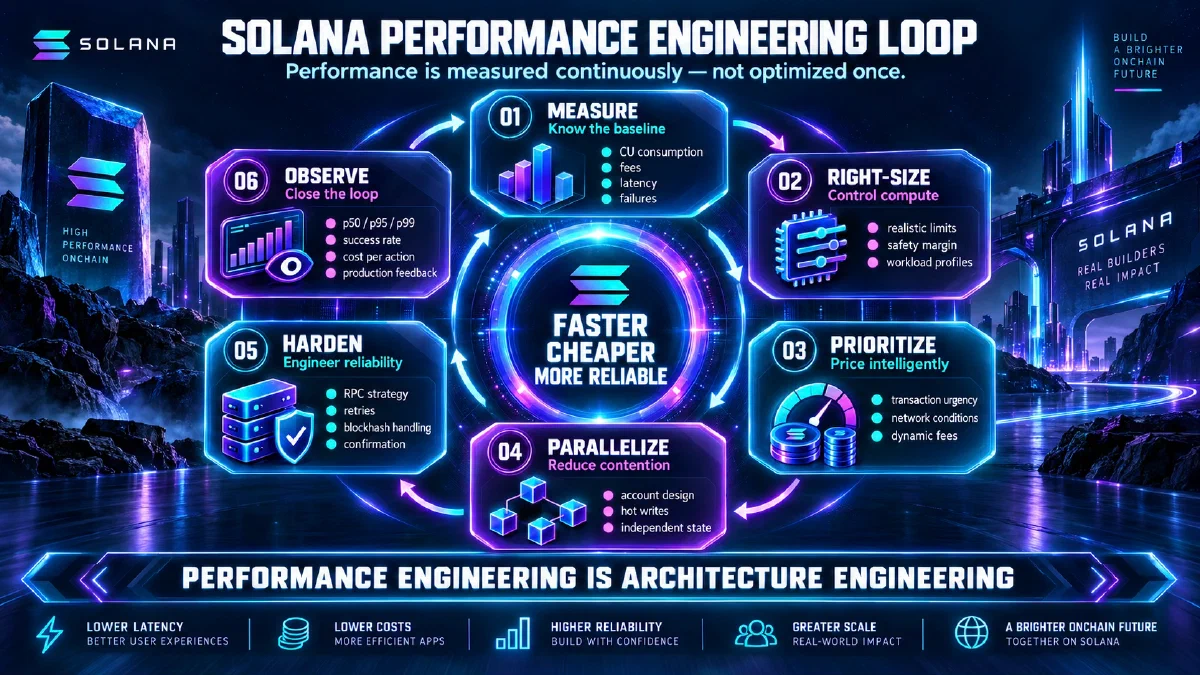
A Practical Solana Performance Engineering Workflow
- Measure: Profile compute consumption, fees, latency, failures, and confirmation behavior.
- Right-Size: Set realistic compute budgets based on measurements rather than defaults.
- Prioritize: Build fee policies around transaction urgency and current network conditions.
- Parallelize: Identify account contention and redesign unnecessary serialization points.
- Harden: Improve RPC architecture, blockhash handling, confirmation tracking, retries, and observability.
- Observe and Re-Evaluate: Repeat the cycle as application usage, network conditions, and Solana itself evolve.
Looking Ahead: Solana’s Transaction Model Is Still Evolving
Teams should avoid hard-wiring their architecture to today’s assumptions. Solana’s current versioned-transaction documentation describes an upcoming v1 format that raises the transaction-size limit to 4,096 bytes, moves resource limits into the message, and removes Address Lookup Tables. The documentation states that v1 is not yet active on any cluster at the time of writing. Versioned Transactions
That distinction matters. Architecture should be based on what is available today while remaining adaptable to what is coming next. Forward-looking engineering does not mean adopting unreleased functionality early; it means avoiding assumptions that make future migration unnecessarily expensive.
Client infrastructure should also be ready to declare the highest transaction version it can handle so RPC responses do not fail as newer formats become available.
Key Takeaways
- Solana’s network performance does not eliminate the need for application-level performance engineering.
- Compute-unit requests should be measured and right-sized rather than generously over-provisioned.
- Requested compute and priority pricing should be optimized together.
- Account design influences how much parallelism an application can exploit.
- End-to-end latency includes blockhash retrieval, signing, RPC submission, routing, scheduling, execution, confirmation, and application feedback.
- Transaction retries and blockhash expiration should be explicitly engineered.
- Performance metrics should connect technical behavior with the user’s actual experience.
- Persistent performance problems are often architectural problems rather than isolated code problems.
Conclusion
Solana provides an impressive high-performance foundation, and the network itself continues to evolve. But infrastructure performance and application performance are not the same thing.
Production-grade Solana systems require deliberate decisions about compute, transaction economics, account access, RPC infrastructure, retry behavior, observability, and software architecture.
The strongest engineering teams therefore do not ask only, “How many transactions can Solana process?” They ask, “How efficiently and reliably does our application use the performance Solana makes available?”
That question ultimately determines whether a Solana application merely works or is ready to scale.
Frequently Asked Questions
What is a compute unit on Solana?
A compute unit is Solana’s measurement of computational work during transaction execution. Transactions operate within a compute budget, making CU consumption relevant to both program efficiency and transaction economics.
Does requesting more compute make a transaction faster?
Not necessarily. Extra compute does not make inefficient logic faster, and for legacy/v0 transactions the prioritization fee is based on requested rather than actual compute. Oversizing the limit can therefore increase cost without fixing the underlying bottleneck.
Are priority fees always necessary?
No. Their usefulness depends on congestion, transaction urgency, and the application’s reliability requirements. A dynamic strategy is usually more appropriate than applying one static fee to every operation.
Why can a valid Solana transaction still be dropped?
Transactions can be affected by congestion, RPC rebroadcast behavior, blockhash synchronization issues, network conditions, and temporary forks before successful inclusion and confirmation.
Is Solana performance optimization mainly a smart-contract problem?
No. Program code is only one layer. Account architecture, transaction construction, RPC infrastructure, priority fees, retry strategy, confirmation handling, and user-facing application behavior all contribute to performance.
When does a Solana performance problem become an architecture problem?
When bottlenecks repeatedly reappear across compute limits, account contention, transaction delivery, RPC behavior, retries, or observability, local tuning may no longer be enough. At that point, an architecture review can identify which system boundaries or infrastructure choices are constraining performance.
Sources and Further Reading
- Solana Documentation — Fees — Base fees, prioritization fees, and fee mechanics.
- Solana Documentation — Compute Budget — CU limits, priority-fee relationship, safety-margin guidance, and resource limits.
- Solana Documentation — Fee Structure — Current fee formulas for legacy and v0 transactions.
- Solana Cookbook — Retrying Transactions — Dropped transactions, rebroadcasting, and retry control.
- Solana Cookbook — Transaction Confirmation & Expiration — Blockhash validity, expiration, and confirmation behavior.
- Solana Documentation — Production Readiness — Practical production submission and retry settings.
- Solana Documentation — Stake-weighted QoS — Transaction-delivery quality of service for staked-validator paths.
- Solana — XDP High-Performance Networking — 2026 validator networking and block-propagation improvements.
- Solana Cookbook — Versioned Transactions — Current transaction versions and upcoming v1 behavior.
- Solana Whitepaper — A New Architecture for a High Performance Blockchain — Foundational architecture and Proof of History background.
- Anjana, Ravi & Herlihy — Blockchain Transaction Conflicts: A Historical Perspective — Empirical analysis of transaction conflicts and parallelism, including Solana.
- Dynamic Pricing for Non-fungible Resources: Designing Multidimensional Blockchain Fee Markets — Research background on pricing heterogeneous blockchain resources.

Alexander Nickol
Software Architect & Developer
I'm passionated about programming languages and software architecture. I can offer a great versatility of skills, entrepreneurial behavior and solution-oriented thinking in areas such as Software Architecture, Software Design and Software Development in Rust and Java.
Related Articles
The Strangler Fig Pattern: Modernizing Legacy Systems Step-by-Step with Rust
Learn how the Strangler Fig pattern replaces legacy systems step-by-step with microservices, reducing the risks of complex system migrations.
AI-Assisted Software Development in 2026: How to Use Coding Agents Without Creating Technical Debt
Discover how coding agents are transforming software delivery in 2026, where they create the most value, and the architectural and governance guardrails needed to prevent technical debt.
Migrating C++ to Rust: Incremental Modernization Without a Full Rewrite
Learn how organizations incrementally modernize legacy C++ systems with Rust to limit risks and avoid the high costs of a complete rewrite.