AI-Assisted Software Development in 2026: How to Use Coding Agents Without Creating Technical Debt
Discover how coding agents are transforming software delivery in 2026, where they create the most value, and the architectural and governance guardrails needed to prevent technical debt.
Table of Contents
AI-assisted software development is no longer mainly about faster code completion. In 2026, coding agents can inspect repositories, modify multiple files, run commands and tests, work asynchronously, and prepare pull requests for review. That creates real leverage, but it also changes the risk profile of software delivery. The constraint is no longer how quickly code can be generated; it is whether your architecture, CI/CD pipeline, review process, security controls, and engineering organization can absorb that speed without turning today’s productivity gain into tomorrow’s maintenance cost.
This article looks at where coding agents create real value, where they can accelerate technical debt, and which guardrails help teams increase agent autonomy without losing architectural control.
AI-Assisted Software Development Has Moved Beyond Autocomplete
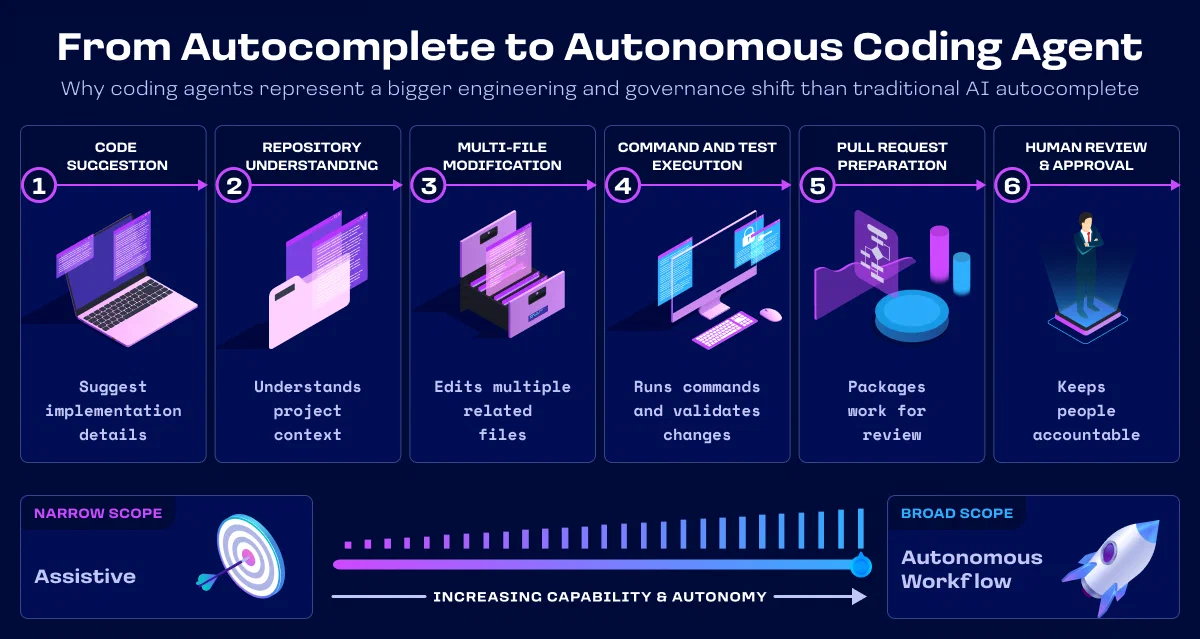
An AI coding assistant primarily helps a developer write, understand, or transform code. A coding agent goes further: it can take a task, plan a sequence of actions, use development tools, and return a reviewable change. Current GitHub workflows, for example, allow coding agents to work asynchronously and create pull requests, while platforms such as Codex support multi-step work including features, refactoring, and migrations.
| Capability | Coding Assistant | Coding Agent |
|---|---|---|
| Interaction Model | Reactive (Autocomplete & Chat) | Autonomous (Goal-driven execution) |
| Scope of Action | Single file or localized snippets | Multi-file orchestration & refactoring |
| Context Awareness | Active file & limited local context | Comprehensive workspace understanding |
| Tool Execution | Read-only / Requires human execution | Runs builds, tests, and shell commands |
| Task Complexity | Single-step (e.g., “Write a function”) | Multi-step (Research, plan, execute, verify) |
| Error Handling | Human must diagnose and re-prompt | Self-correcting (Analyzes logs and retries) |
The distinction that matters is decision scope. Autocomplete proposes an implementation detail. An agent can make several implementation choices across a repository before a developer sees the resulting diff. That is why agentic development is not only a productivity question. It is also an architecture, security, and governance question.
Why Coding Agents Can Accelerate Technical Debt
- Technical debt is not a synonym for bad code. It is the future cost created when today’s implementation choices make tomorrow’s changes harder to understand, modify, test, secure, or operate.
- Coding agents do not automatically create technical debt. The risk appears when the cost of generating a change falls dramatically while the cost of understanding its architectural consequences does not.
- DORA’s 2025 research describes AI as an amplifier. In its study of nearly 5,000 technology professionals, higher AI adoption was associated with stronger software-delivery throughput and product performance, while delivery stability still showed a negative relationship. The practical lesson is simple: faster change can expose weaknesses elsewhere in the delivery system.
Code That Works Is Not Necessarily Code That Belongs
Imagine asking an agent to add customer notifications. The change passes the existing test suite, but the agent also introduces a second notification abstraction, reads customer data directly from another module’s database tables, adds a new library for functionality that already exists internally, and places domain logic inside an API controller.
- Functionally, the feature works.
- Architecturally, the system has become worse.
This is the difference between local correctness and architectural correctness. Tests can verify expected behavior, but they do not automatically prove that a change respects domain boundaries, dependency rules, data ownership, security requirements, or the intended direction of the system.
Faster Generation Can Move the Bottleneck to Review
- AI also changes the economics of code review. Generating another pull request may become inexpensive, but reviewing it still requires someone to understand the requirement, architecture, failure modes, and long-term maintenance implications.
- Google’s 2026 DORA ROI guidance highlights the same systems effect: when developers produce changes faster, downstream testing and approval processes can become the bottleneck unless the delivery pipeline evolves with them.
- GitHub therefore recommends reviewing agent-created pull requests with the same rigor as other contributions. Faster generation does not remove the need for engineering judgment.
Where Coding Agents Deliver the Most Value
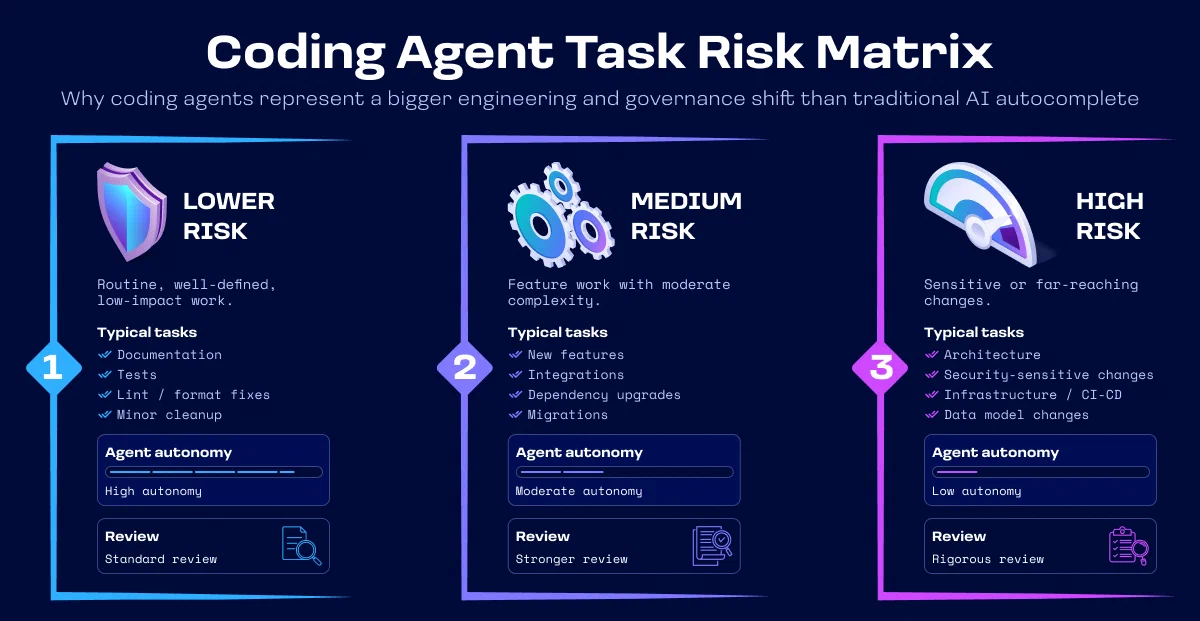
The safest adoption model is bounded autonomy: give an agent enough freedom to complete useful work, while constraining the task, permissions, and acceptance criteria according to risk.
| Risk | Suitable Examples | Oversight |
|---|---|---|
| Lower | Documentation, test scaffolding, lint fixes, well-defined refactoring | Normal CI and review |
| Medium | Features, integrations, dependency changes, migrations with clear acceptance criteria | Stronger tests and experienced review |
| High | Authentication, architecture boundaries, production infrastructure, sensitive data, irreversible migrations | Human-led decision-making |
The deciding factor should not be how capable the agent appears. It should be the cost, impact, and reversibility of a wrong decision.
Seven Guardrails for Using Coding Agents Without Creating Technical Debt
1. Make Your Architecture Legible to Agents
Agents cannot reliably follow rules they cannot discover. Keep important architectural guidance close to the repository: module boundaries, data ownership, approved dependencies, API conventions, testing expectations, security constraints, architectural decision records, and patterns that should not be introduced. The goal is not more documentation. It is current, actionable context that helps both people and agents understand how the system is meant to evolve.
2. Keep Agent-Generated Changes Small
“Modernize the backend” is too broad to review safely. A task such as “extract this module behind the existing interface, migrate one consumer, preserve the current contract, and run these tests” is much easier to verify. Small changes reduce reviewer cognitive load, expose assumptions earlier, and make rollback simpler when the agent misunderstood the requirement.
3. Strengthen Automated Quality Gates Before Increasing Autonomy
Agent-generated code should pass the same engineering controls as human-written code. Depending on the system, that can include unit and integration tests, type checking, static analysis, linting, API contract tests, dependency scanning, secret detection, and security analysis. Automated checks cannot replace architectural judgment, but they are the first scalable defense when the volume of changes increases.
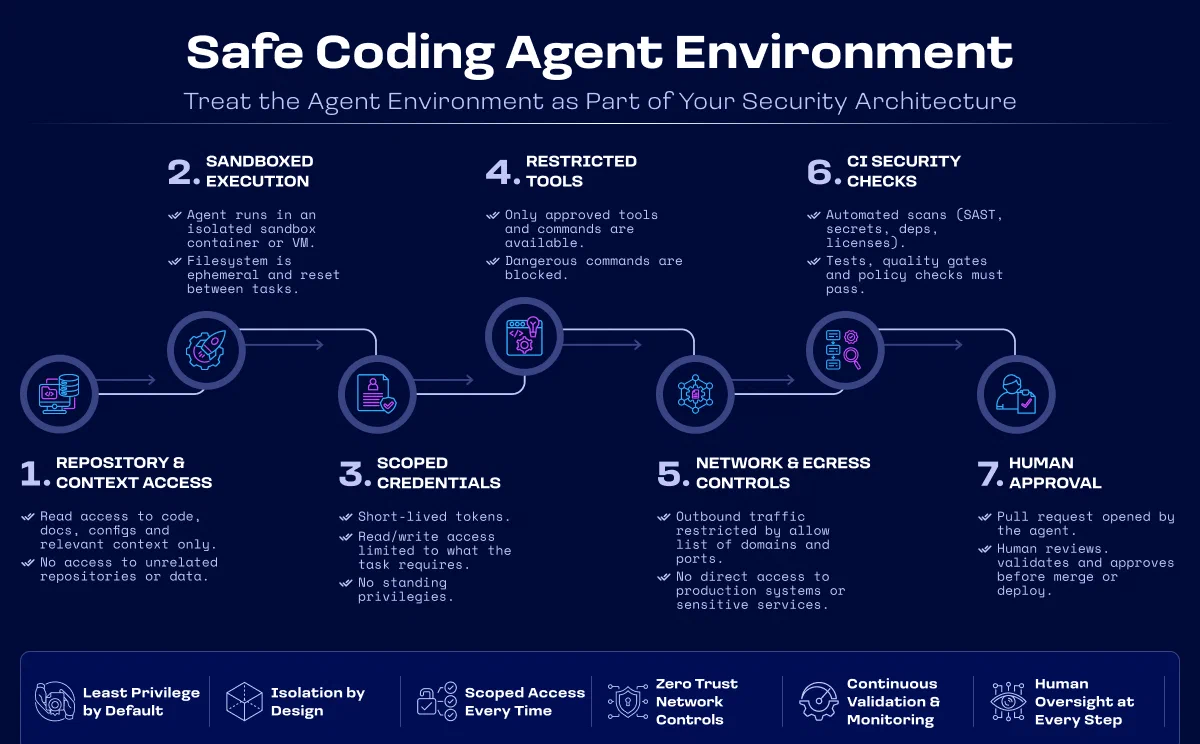
4. Apply Least Privilege and Sandbox Agent Execution
A coding agent that can execute commands is part of your security model. OWASP’s current guidance recommends sandboxing agent runtimes, limiting file-system and tool access, using scoped or ephemeral credentials, restricting unnecessary network access, and treating repository content and external information as potentially untrusted input. OWASP also identifies indirect prompt injection as a development-loop risk because malicious instructions can arrive through issues, documentation, pull-request comments, web pages, or connected tools. An agent changing tests does not need production credentials, and an agent editing frontend code does not need cloud-administration permissions.
5. Govern Dependencies Deliberately
Adding a dependency to a new package is sometimes the fastest way for an agent to satisfy a prompt. It can also introduce vulnerabilities, licensing concerns, and transitive dependencies, upgrade work, and another component the organization must maintain. Require explicit justification for new dependencies and apply normal supply-chain checks. The objective is not zero dependencies; it is intentional dependency growth.
6. Review Architectural Intent, Not Only Code Syntax
The most useful review question for agent-generated code is not only “Does this work?” Reviewers should also ask whether the change belongs in this module, respects established data boundaries, duplicates an existing capability, introduces unnecessary abstraction, handles failure modes, and remains understandable without access to the original agent conversation. Software is maintained far longer than it is generated.
7. Keep Humans Accountable for Architecture
Coding agents can help teams explore architecture. They can map dependencies, summarize unfamiliar components, compare alternatives, and prepare refactoring work. They should not own the architectural decision. Product strategy, regulatory obligations, expected growth, migration budgets, team capabilities, operational risk, and future business plans often sit outside repository context. The agent can provide options; engineering leadership remains accountable for the consequences.
A Practical Governance Model for Coding Agents
Companies do not need a heavyweight AI governance program before they experiment with coding agents. They do need clear answers to four questions: what agents may do, what rules they must follow, what they may access, and what must happen before a change is merged.
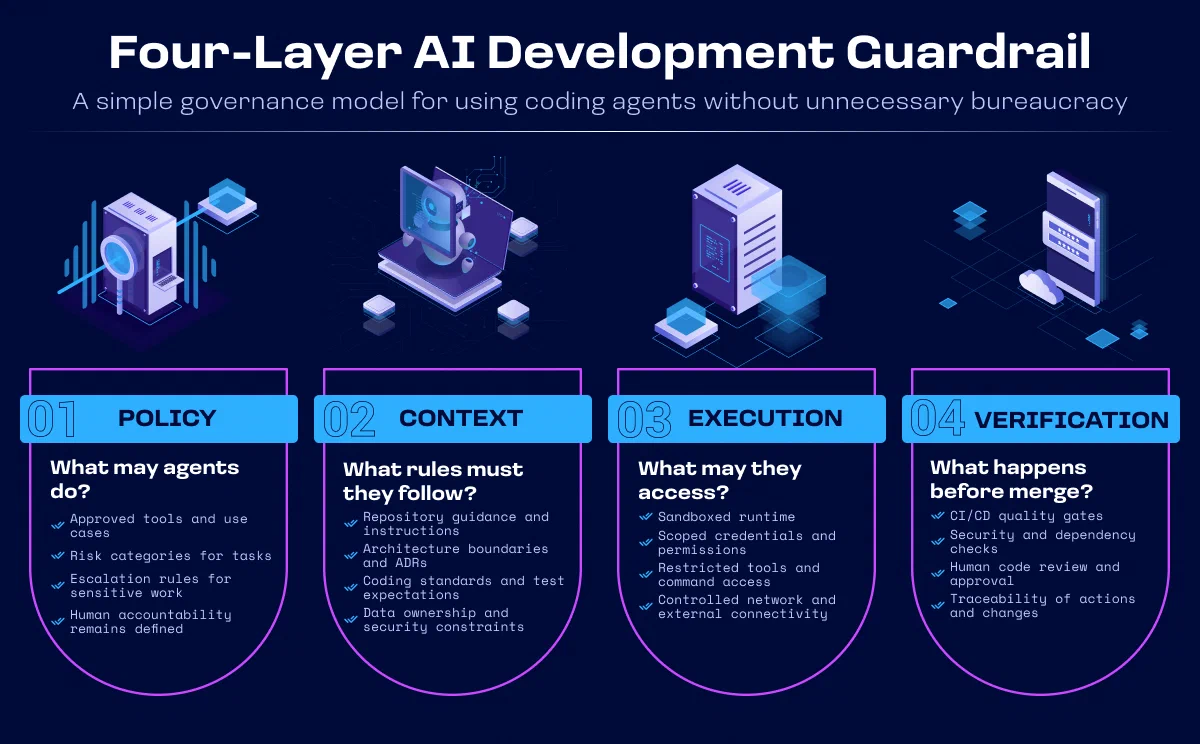
| Layer | Question | Typical Control |
|---|---|---|
| Policy | What may agents do? | Approved tools and use cases |
| Context | What rules must they follow? | Repository guidance and architecture constraints |
| Execution | What may they access? | Sandboxes, scoped credentials, tool restrictions |
| Verification | What happens before merge? | CI/CD gates and human review |
This approach also fits the principle behind NIST’s Secure Software Development Framework: security should be integrated throughout the software development lifecycle rather than added as a final inspection. AI-generated changes should stay inside the existing secure development process, not become a shortcut around it.
Measure Outcomes, Not AI-Generated Code
Lines of code and the number of agent-created pull requests measure activity, not value.
A more useful scorecard combines delivery speed with quality, reliability, and maintenance outcomes:
- Lead time for changes and deployment frequency;
- Change failure rate and escaped defects;
- Review time and agent-related rework;
- Security findings;
- Unnecessary dependency or duplication growth;
- Maintainability of frequently changed components.
Google’s 2026 DORA ROI guidance takes the same direction by focusing on how engineering velocity translates into business value and how much rework is avoided. The real question is whether AI creates additional engineering capacity without converting today’s time savings into tomorrow’s maintenance bill.
A Stage-by-Stage Adoption Roadmap
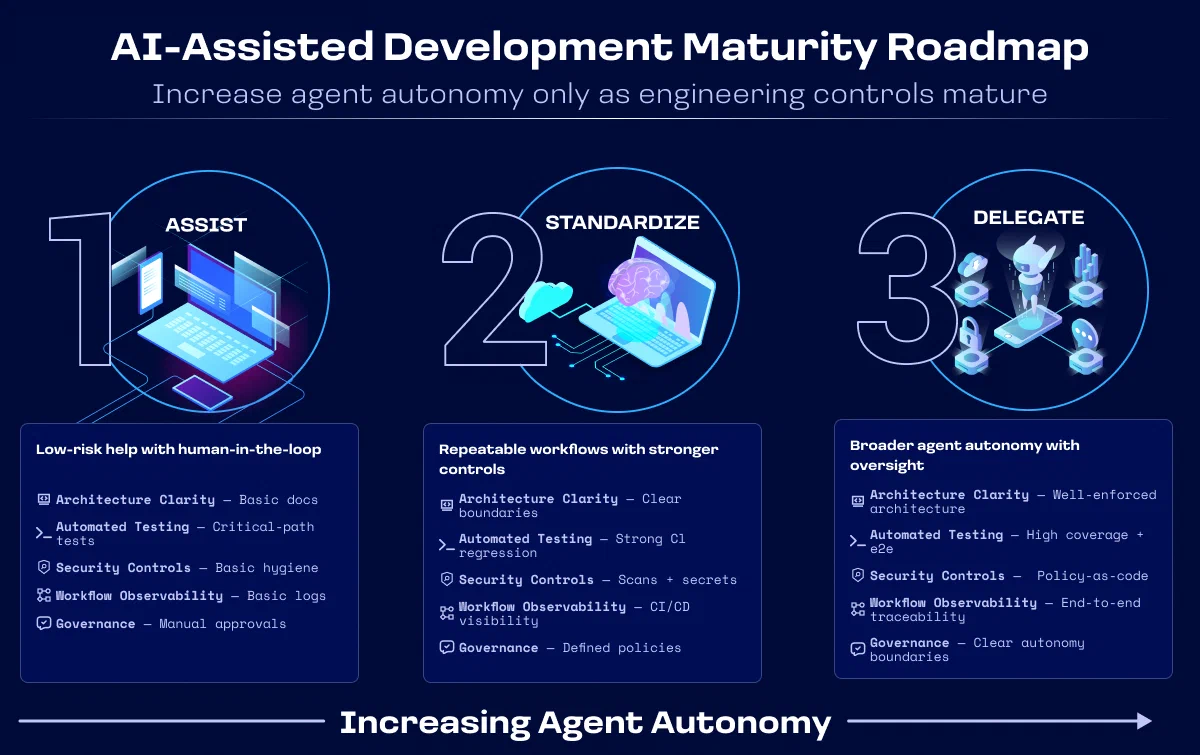
Stage 1: Assist
- Start with low-risk, easily verified work: documentation, code explanation, tests, isolated bug fixes, and well-defined refactoring.
- Keep permissions narrow and normal review requirements in place. The goal is to learn where agents are reliable in your actual codebase before increasing scope.
Stage 2: Standardize
- Turn successful experiments into repeatable engineering practice.
- Define repository instructions, quality gates, dependency policies, security controls, review expectations, and the categories of work that require senior approval.
- At this stage, the goal is consistent quality, not isolated productivity wins.
Stage 3: Delegate
- Expand into larger asynchronous or parallel agent workflows only after those controls are working reliably.
- Add observability for agent activity: what changed, which tools were used, which tests ran, what permissions were granted, who reviewed the work, and where rework is being created.
More autonomy should come with stronger feedback and governance, not less.
The Business Value Is Controlled Engineering Speed
The business case for coding agents is not “more code.” Most organizations are not constrained by a shortage of source lines. The value is additional capacity for useful engineering work while experienced people stay focused on architecture, security, product decisions, reliability, and difficult system changes.
When the surrounding architecture is healthy, AI-assisted development can help teams move routine implementation work faster. When the architecture is tightly coupled, poorly documented, or already carrying substantial technical debt, more change volume can simply expose those weaknesses sooner.
That makes coding-agent adoption a useful architecture checkpoint. If your team can generate changes faster than it can safely review, integrate, and operate them, the real constraint may no longer be developer productivity. It may be the software architecture and delivery system underneath it.
Key Takeaways
- Coding agents can operate across repositories and development workflows, not merely suggest snippets.
- AI can increase delivery throughput without automatically improving delivery stability.
- Bounded autonomy is safer than giving every agent the same scope and permissions.
- Architecture rules, automated quality gates, sandboxing, dependency governance, and human review become more important as agent autonomy increases.
- Measure rework, reliability, maintainability, and business outcomes alongside speed.
- Keep human engineering leaders accountable for architectural decisions.
Conclusion
AI-assisted software development in 2026 is best treated as a change to the engineering system, not simply as a new developer tool.
Coding agents can make a strong development organization faster. They can also accelerate duplication, architectural drift, weak dependency choices, security exposure, and technical debt when the surrounding controls are not ready.
The sustainable approach is straightforward: increase agent autonomy only as your architecture, testing, review process, security controls, and feedback loops become capable of supporting it.
If your organization is already dealing with architectural complexity, technical debt, or a modernization roadmap, coding agents can expose those constraints quickly. trust!NICKOL helps companies evaluate software architectures, design robust governance frameworks for AI-assisted engineering, and make technical decisions that support faster delivery without sacrificing long-term maintainability.
Talk to an architecture consultant today!
Frequently Asked Questions
What is AI-assisted software development?
AI-assisted software development uses AI to support activities such as code generation, testing, debugging, documentation, refactoring, review, and repository analysis. Agentic workflows go further by allowing AI systems to take multiple actions toward completing an engineering task.
What is a coding agent?
A coding agent is an AI system that can act within a development environment rather than only suggest code. Depending on its tools and permissions, it may explore repositories, edit files, execute commands, run tests, and prepare changes for review.
Do AI coding agents create technical debt?
Not automatically. The risk increases when agents produce changes faster than teams can enforce architecture, testing, dependency, security, and review standards. Agents can also reproduce inconsistencies that already exist in the codebase.
Which tasks are safest to delegate to coding agents?
Good starting points are tasks with narrow scope and clear acceptance criteria, such as documentation, tests, code explanation, lint fixes, well-specified bugs, and mechanical refactoring. Higher-risk work requires stronger human involvement.
Should AI-generated production code receive human review?
Yes. Human accountability should remain in the process, especially for security, architecture, infrastructure, business logic, public APIs, and sensitive data. Review depth can be risk-based, but AI-generated changes should not bypass normal engineering controls simply because an agent produced them.
How can companies prevent AI-generated technical debt?
Use clear architectural constraints, small reviewable changes, automated testing and security checks, least-privilege permissions, sandboxed execution, dependency governance, human ownership of architecture, and metrics that track rework, defects, reliability, and maintainability.

Alexander Nickol
Software Architect & Developer
I'm passionated about programming languages and software architecture. I can offer a great versatility of skills, entrepreneurial behavior and solution-oriented thinking in areas such as Software Architecture, Software Design and Software Development in Rust and Java.
Related Articles
Performance Engineering on Solana in 2026: Optimizing Compute, Costs, and Latency
Optimize Solana compute units, priority fees, and end-to-end latency in 2026 with practical guidance for reliable, production-grade applications.
How to Design Software That Can Scale from Startup to Enterprise
Learn how to design scalable software with a practical, stage-by-stage framework covering architecture patterns, database scaling, and cloud infrastructure from startups to enterprise teams.
When Should You Hire a Software Architecture Consultant?
Learn when to hire a software architecture consultant by recognizing the key signs of scalability issues, technical debt, performance bottlenecks, and application modernization needs.