When Should You Hire a Software Architecture Consultant?
Learn when to hire a software architecture consultant by recognizing the key signs of scalability issues, technical debt, performance bottlenecks, and application modernization needs.
Table of Contents
Your software rarely fails overnight. More often, it slows down in ways that seem manageable at first. Features take longer to build. Infrastructure costs rise. Teams become cautious about making changes. By the time these issues become impossible to ignore, fixing them is far more expensive than preventing them.
That is why many businesses ask when to hire a software architecture consultant only after growth starts exposing weaknesses in their systems. According to McKinsey, organizations that modernize their technology foundation early are more likely to improve delivery speed, reduce costs, and adapt to changing business needs than those that delay architectural improvements.
This guide explains the right time to seek software architecture consulting, the warning signs that deserve attention, and the value an experienced consultant brings before technical debt turns into a business problem.
The Short Answer: When Is the Right Time to Hire a Software Architecture Consultant?
The simplest answer is this:
You should hire a software architecture consultant before your next major technical decision becomes difficult, expensive, or risky to reverse. If correcting that decision would take months instead of weeks, outside expertise usually delivers a better return than solving the problem after deployment.
Think about the next strategic changes on your roadmap. They might include:
- Migrating to the cloud.
- Modernizing an aging application.
- Redesigning a core platform.
- Supporting thousands of new users.
- Integrating multiple enterprise systems.
Each decision affects performance, scalability, security, and long-term development costs. A consultant evaluates these decisions before they become permanent architectural commitments.
Many leadership teams wait until users complain or developers request a complete rewrite. In reality, the best time for software architecture consulting services is when your product is growing successfully, not when it is already struggling.
What Does a Software Architecture Consultant Do?
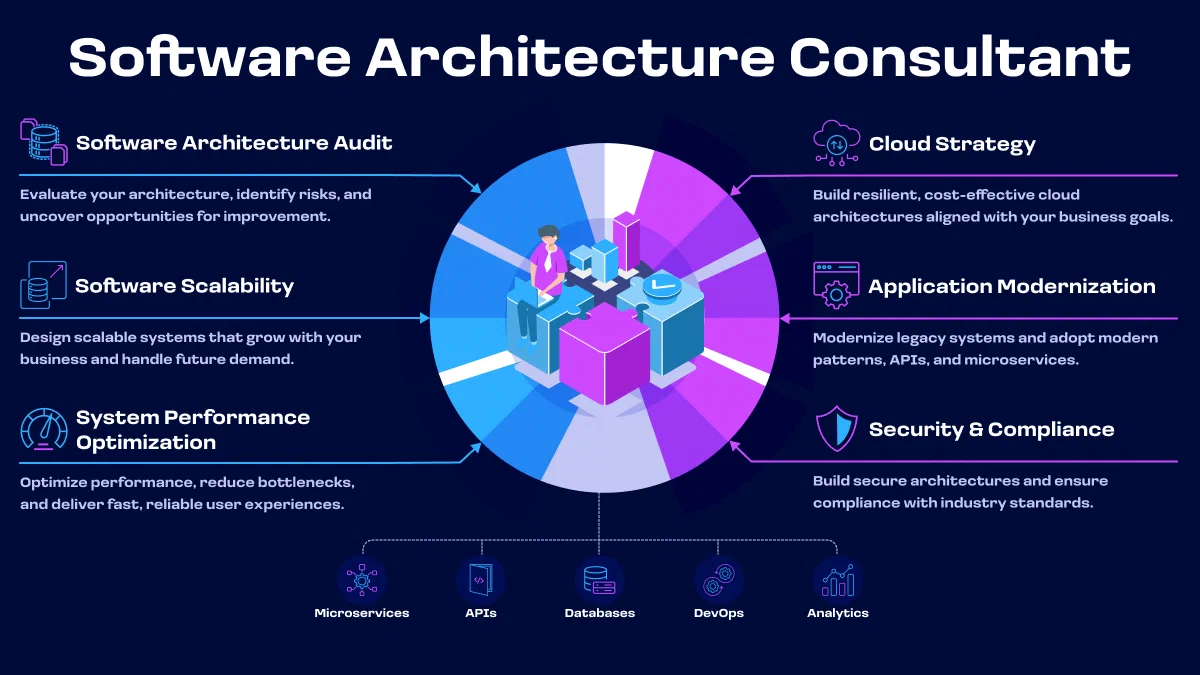
A software architecture consultant helps businesses build technology that supports long-term growth rather than short-term fixes. Instead of focusing on writing features, they evaluate how every technical decision affects future scalability, maintainability, and business performance.
Their work usually includes:
- Performing a software architecture audit.
- Identifying scalability bottlenecks.
- Improving system performance optimization strategies.
- Recommending technology and infrastructure improvements.
- Creating an architecture roadmap for future growth.
- Supporting technical debt reduction initiatives.
Unlike developers who concentrate on implementation or CTOs who balance multiple business priorities, consultants provide an independent perspective. They identify risks that internal teams often overlook because they work too closely with the existing system.
Their objective is not simply to solve today’s challenges. It is to create scalable software systems that continue supporting your business as customer demand, product complexity, and operational requirements evolve.
8 Signs It’s Time to Hire a Software Architecture Consultant
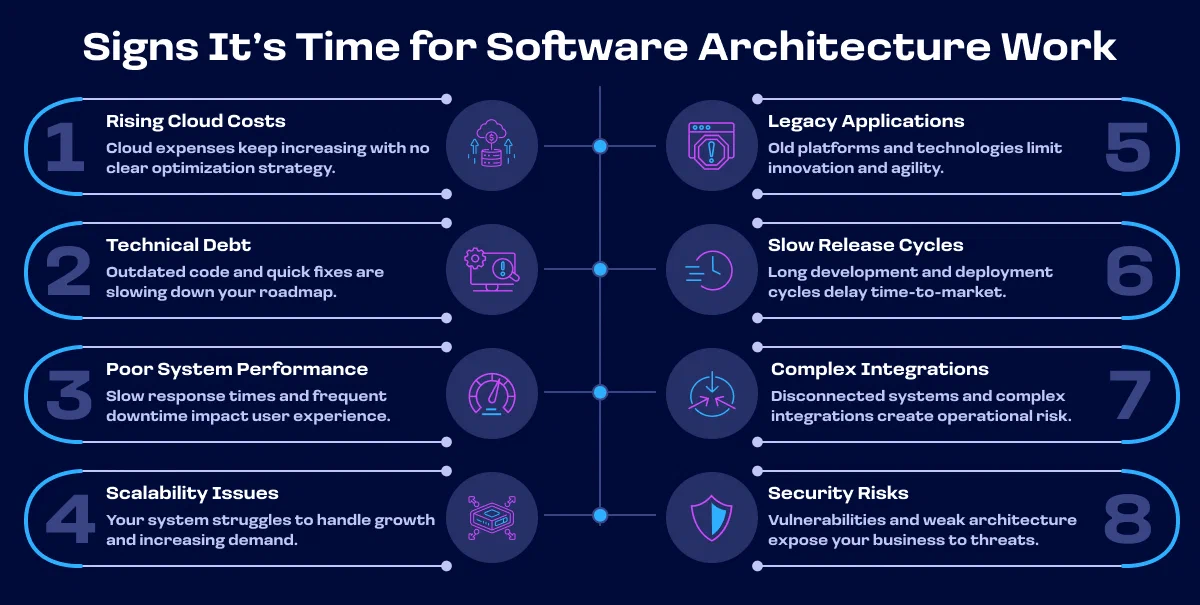
Growth rarely breaks software in a single release. It exposes architectural decisions that once worked but no longer support the business. If several of the following signs sound familiar, an enterprise software architecture consultant can often prevent months of expensive rework.
1. Your Application Struggles to Scale with User Growth
Adding new customers should increase revenue, not technical stress. When every traffic spike requires emergency infrastructure changes, the architecture is no longer keeping pace with the business.
Well-designed systems scale predictably. Poorly designed ones consume more resources while delivering diminishing returns. According to Google Cloud, scalability planning should happen before demand outgrows the original architecture, not after outages become routine.
2. System Performance Keeps Declining
Slow response times often appear gradually. Teams optimize databases, increase server capacity, or introduce caching, yet performance problems continue returning.
That usually indicates an architectural issue instead of an infrastructure issue. An experienced consultant evaluates data flow, service communication, and dependency patterns to improve system performance optimization without relying on endless hardware upgrades.
3. Technical Debt Is Slowing Every Release
Technical debt is not simply messy code. It is the accumulated cost of decisions that were acceptable yesterday but create obstacles today.
If developers spend more time working around limitations than building new functionality, technical debt reduction should become a business priority. Addressing it early improves delivery speed and lowers future maintenance costs.
4. You’re Planning Application Modernization
Modernizing an existing platform involves much more than replacing old technology. Every migration affects integrations, security, performance, and future maintenance.
Before starting application modernization, a consultant identifies which components should remain, which require redesign, and which create unnecessary risk. That roadmap helps avoid costly migration mistakes.
5. Your Development Team Lacks Architecture Expertise
Strong developers do not automatically become experienced architects. Designing software for long-term business growth requires a different mindset than building individual features.
Bringing in a consultant gives the team access to proven architectural patterns while allowing developers to stay focused on execution. It also reduces costly trial-and-error during critical projects.
6. You’re Migrating to the Cloud or Microservices
Cloud migration and microservices promise flexibility, but poor planning often creates more complexity than value. Simply moving workloads does not guarantee better performance or lower costs.
A consultant evaluates service boundaries, deployment strategies, and operational risks before migration begins. That planning prevents architecture decisions that become difficult to reverse later.
7. Enterprise Integrations Are Becoming More Complex
As businesses grow, software must exchange information with CRMs, ERPs, payment gateways, analytics platforms, and third-party APIs. Every new integration increases architectural complexity.
Without a clear integration strategy, changes in one system begin affecting several others. A consultant designs stable communication patterns that reduce future maintenance and improve reliability.
8. You’re Preparing for Rapid Business Growth
Hiring new teams, entering new markets, or launching major products places pressure on technology that may have been designed for a much smaller business.
Preparing early allows software architecture consulting services to strengthen the foundation before growth accelerates. That approach reduces operational risk while giving leadership greater confidence in future expansion.
Why Hiring Early Saves More Than Waiting for Problems
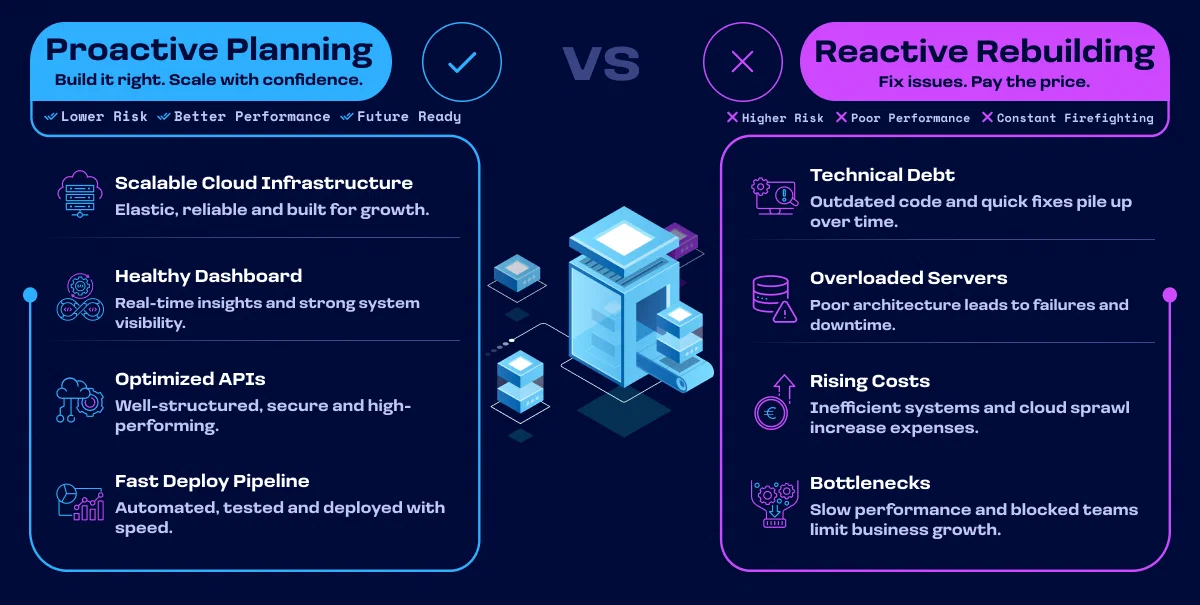
Many businesses delay architecture decisions because the product still works. The problem is that working software is not always scalable software. By the time failures become visible, fixing them usually requires far more time and budget than preventing them.
Research from Gartner consistently shows that technical debt reduces delivery speed and increases long-term maintenance costs. Investing in architecture early protects both engineering productivity and business momentum.
Lower Development Costs
Early architectural guidance helps teams avoid rebuilding core components later. Instead of replacing entire systems, they make smaller, planned improvements that cost less and create fewer disruptions.
Every avoided rewrite saves development hours, testing effort, and deployment risk. That is one of the biggest financial benefits of working with a software architecture consultant before problems escalate.
Faster Product Delivery
Development slows when teams constantly work around architectural limitations. Features require additional reviews, unexpected fixes, and repeated testing because dependencies have become difficult to manage.
A cleaner architecture removes unnecessary friction. Developers spend more time delivering customer value and less time solving problems created by the existing system.
Reduced Business Risk
Every major technology decision carries business consequences. Choosing the wrong architecture can delay launches, interrupt customer experiences, or increase operational expenses for years.
An independent consultant evaluates these risks before implementation begins. That outside perspective often identifies issues internal teams overlook because they are focused on day-to-day delivery.
Better Long-Term Scalability
Businesses rarely stay the same size for long. Customer growth, new products, and market expansion all increase pressure on existing platforms.
Building scalable software systems from the beginning allows technology to support growth instead of limiting it. That creates a stronger foundation for future innovation without constant architectural redesign.
What to Expect from Software Architecture Consulting Services
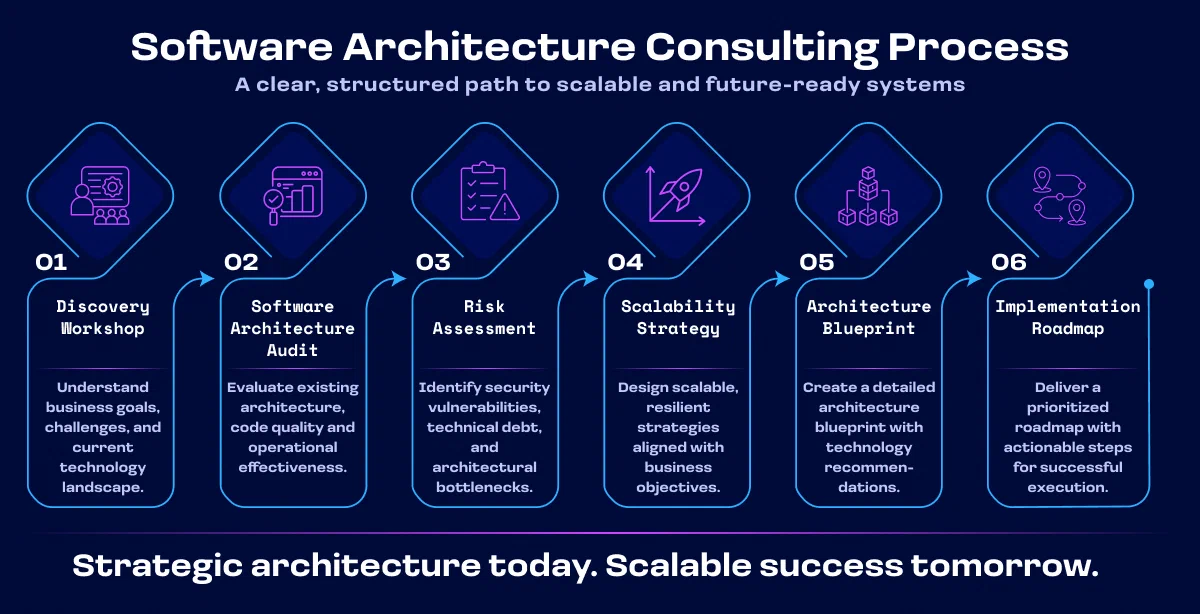
A successful engagement should deliver more than recommendations. It should give your business a practical roadmap that improves decision-making long after the consultant leaves.
The best software architecture consulting services focus on measurable outcomes rather than lengthy reports that rarely influence future development.
A Typical Engagement Includes
- A comprehensive software architecture audit.
- Assessment of scalability, security, and system dependencies.
- Identification of performance bottlenecks.
- Technology stack recommendations aligned with business goals.
- A phased implementation roadmap with clear priorities.
- Risk analysis and mitigation strategies.
- Documentation that supports future architectural decisions.
The most valuable outcome is clarity. Instead of reacting to technical issues one sprint at a time, leadership gains a long-term strategy that aligns engineering investments with business growth.
How to Choose the Right Software Architecture Consultant
Not every consultant brings the same level of strategic thinking. Some focus only on solving today’s technical issues, while others help shape technology that supports the business for years. The difference becomes obvious during the first few conversations.
A strong consultant asks about business goals before discussing frameworks or programming languages. They understand that architecture exists to support growth, customer experience, and operational efficiency.
Look for These Qualities
- Proven experience with projects similar to yours.
- Strong communication with both technical and business teams.
- A practical approach instead of one-size-fits-all recommendations.
- Experience designing scalable, secure platforms.
- Clear documentation and actionable architecture roadmaps.
- The ability to work alongside your existing engineering team.
Choosing the right expert is less about finding someone who knows every technology. It is about finding someone who understands which architectural decisions will create long-term value for your business.
Final Thoughts
The best time to hire a software architecture consultant is before technical challenges begin slowing your business. Waiting until performance issues, rising cloud costs, or growing technical debt become daily obstacles often turns a manageable improvement into an expensive transformation project.
Strong software architecture is not just about choosing the right technologies. It is about making decisions that support future growth, reduce risk, and help development teams move faster with confidence. Every architectural choice influences how easily your business can scale, adapt, and compete.
If your product is growing, your systems are becoming more complex, or your team is questioning major technical decisions, now is the right time to seek expert guidance. Investing in software architecture consulting services early helps you build scalable software systems, improve long-term performance, and avoid costly mistakes before they impact your customers or your bottom line.
Frequently Asked Questions
When should you hire a software architecture consultant?
Hire one before major architectural decisions become expensive to reverse. The ideal time is during periods of growth, cloud migration, application modernization, or increasing technical complexity rather than after performance problems begin affecting customers.
What are the biggest signs your software architecture needs improvement?
Common indicators include rising infrastructure costs, declining performance, growing technical debt, slower release cycles, and systems that struggle to scale as customer demand increases.
How long does a software architecture audit take?
The timeline depends on system size and complexity. Most engagements range from several days for smaller applications to a few weeks for large enterprise platforms requiring a detailed assessment.
Can a consultant work with an in-house development team?
Yes. Most consultants collaborate directly with internal developers, engineering managers, and CTOs. Their goal is to strengthen existing teams by providing strategic guidance rather than replacing internal expertise.
Is hiring a software architecture consultant worth it for startups?
Yes, especially when the product is preparing for rapid growth or attracting enterprise customers. Early architectural decisions reduce future rework and help startups build a stronger technical foundation.

Alexander Nickol
Software Architect & Developer
I'm passionated about programming languages and software architecture. I can offer a great versatility of skills, entrepreneurial behavior and solution-oriented thinking in areas such as Software Architecture, Software Design and Software Development in Rust and Java.
Related Articles
Performance Engineering on Solana in 2026: Optimizing Compute, Costs, and Latency
Optimize Solana compute units, priority fees, and end-to-end latency in 2026 with practical guidance for reliable, production-grade applications.
AI-Assisted Software Development in 2026: How to Use Coding Agents Without Creating Technical Debt
Discover how coding agents are transforming software delivery in 2026, where they create the most value, and the architectural and governance guardrails needed to prevent technical debt.
How to Design Software That Can Scale from Startup to Enterprise
Learn how to design scalable software with a practical, stage-by-stage framework covering architecture patterns, database scaling, and cloud infrastructure from startups to enterprise teams.