How to Design Software That Can Scale from Startup to Enterprise
Learn how to design scalable software with a practical, stage-by-stage framework covering architecture patterns, database scaling, and cloud infrastructure from startups to enterprise teams.
Table of Contents
A bad MVP is not the most common startup software failure. It is a good MVP built on an architecture that cannot support what comes after it. Founders ship fast, land early customers, and assume the codebase will simply “grow” alongside the business. It rarely does, and learning how to design scalable software from the outset is what separates companies that scale smoothly from those forced into a costly rebuild.
This is not a hypothetical risk. Teams that ignore scalable software architecture in the first 12 to 18 months typically face a full or partial rebuild once they cross 10,000 to 50,000 active users, a process that can consume engineering time as well as money. The good news: scalable software does not require enterprise-grade infrastructure on day one. It requires the right decisions, made in the right order, at the right stage of growth.
What “Scalable Software” Actually Means (Beyond Handling More Users)
Software scalability is often reduced to “handling more traffic,” but that framing misses the deeper problem. A system can survive a traffic spike and still fail as a business asset if every new feature requires touching the entire codebase. True scalability is architectural, not just performance-based.
The Difference Between Scaling Performance and Scaling Complexity
Application performance like response times, throughput and uptime is what most teams measure. But system performance under load is only half the equation. The other half is organizational scalability: can five engineering teams work on this codebase simultaneously without stepping on each other? A system that scores well on performance benchmarks can still be structurally unscalable if it can’t support parallel development.
Why “Build for Scale from Day One” Is Often Bad Advice
Premature optimization is one of the most expensive mistakes in designing scalable software early. Teams that architect for millions of users before validating product-market fit routinely burn 30% to 50% more development time on infrastructure that may never be used at that scale. The better principle: build for the scale you can reasonably predict in 3 to 5 years, in a way that doesn’t structurally block the scale you might need in the future.
The Real Cost of Ignoring Scalability Early
Technical Debt That Compounds as Teams Grow
Technical debt behaves like financial debt: small amounts are manageable, but unaddressed debt compounds. A shortcut taken to hit a launch date becomes a blocker for three future features. As team size grows, the interest on that debt is paid not just in dev time, but in slower onboarding and rising incident rates.
Case Pattern: What Happens When Startups Rebuild from Scratch
The recurring pattern across failed-scale rebuilds: a monolith with no internal boundaries, a shared database with no clear data ownership, and a growing engineering team unable to ship without conflicts. The rebuild that follows isn’t really about scalable system design; it’s about untangling years of undocumented coupling, which is far more expensive than building modular boundaries from the start.
Core Principles of Scalable Software Architecture
Four principles determine whether scalable application architecture can grow without a rewrite:
- Loose coupling: independent components should be replaceable without touching unrelated code.
- Statelessness: application servers shouldn’t store session data locally, enabling horizontal scaling.
- Designed redundancy: no single points of failure once real customers depend on uptime.
- Clear data boundaries: each service owns its data, avoiding the tangled migrations that plague monoliths at scale.
Loose Coupling and Modular Design
Modular design means a change to the billing module shouldn’t risk breaking notifications. This is the foundation of software architecture scalability, not a specific pattern, but a discipline applied consistently regardless of which pattern you choose.
Statelessness and Horizontal Scaling
Horizontal scaling (adding more instances rather than bigger ones) only works if application servers are stateless. Session data belongs in a shared store (Redis, a database), not in server memory, or you can’t distribute load across instances reliably.
Designing for Failure (Redundancy and Fault Tolerance)
Enterprise buyers expect cloud scalability to include fault tolerance: no single database instance, no single server, no single region where an outage takes the entire product down. Building this in early, even minimally, is far cheaper than retrofitting it under an enterprise SLA deadline.
Choosing the Right Architecture Pattern for Your Growth Stage
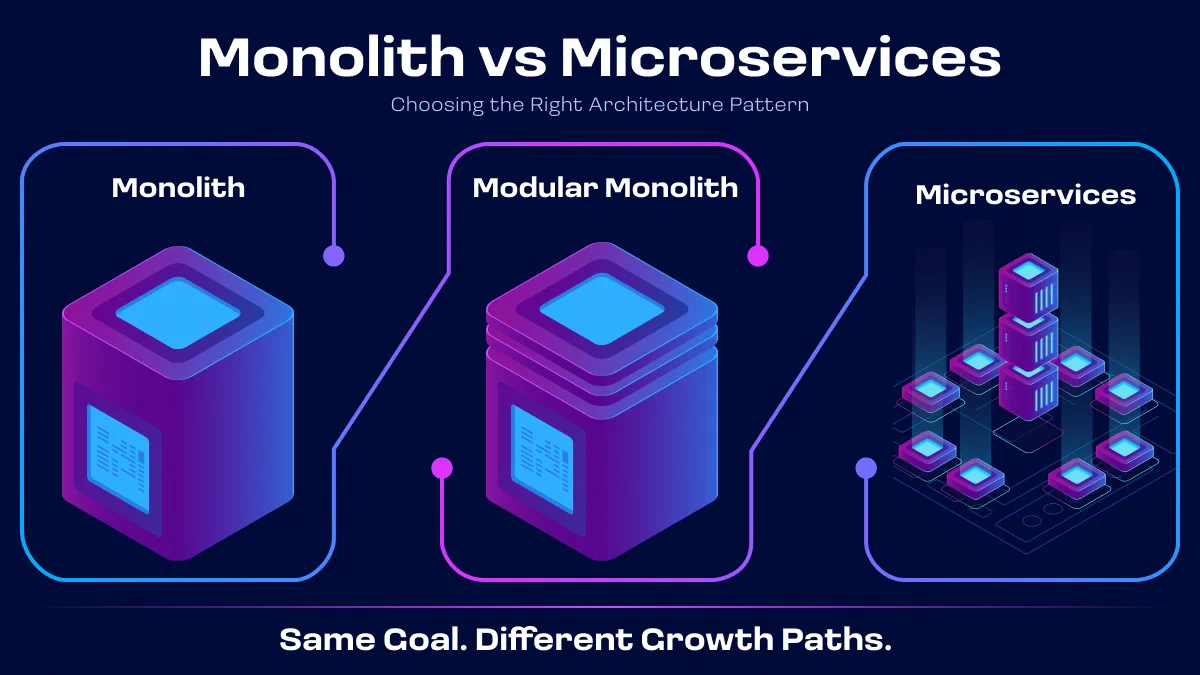
| Monolith | Modular Monolith | Microservices | |
|---|---|---|---|
| Best for | Pre-PMF startups | Growth-stage teams (10 to 50 engineers) | Enterprise, high-scale teams |
| Deployment complexity | Low | Low to Medium | High |
| Operational overhead | Minimal | Moderate | Significant |
| Time to first release | Fastest | Fast | Slowest |
Monolith-First: When It’s Actually the Smarter Choice
A monolith reduces deployment complexity and avoids premature distributed systems problems (network latency, partial failures, cross-service consistency) that small teams aren’t equipped to manage. The mistake isn’t choosing a monolith; it’s building an unstructured one.
Modular Monoliths as a Middle Ground
A modular monolith is a single deployable application internally organized into clearly separated modules with no direct database coupling between them. This is the practical answer for most teams asking how to design scalable software without over-investing in infrastructure they don’t yet need.
Microservices: When You’ve Earned the Complexity
Microservices become justified once team size, deployment independence, or a specific bottleneck warrants the added operational cost. This is typically past 40 to 60 engineers, or when one module’s scaling needs diverge sharply from the rest of the system.
Database Design That Grows With You
Vertical vs. Horizontal Scaling of Data Stores
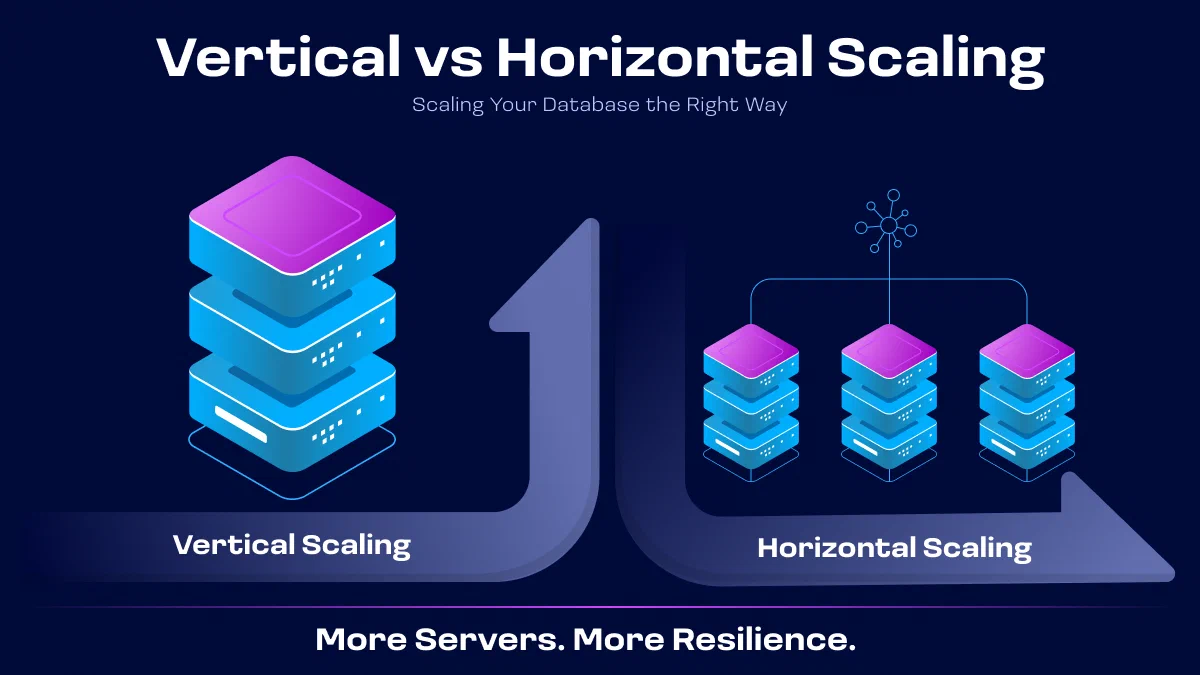
Vertical scaling (bigger servers) is simple but has a ceiling and creates a single point of failure. Horizontal scaling through read replicas and sharding distributes load and supports far higher throughput, at the cost of added consistency complexity.
Sharding, Replication, and Read Replicas Explained
The practical sequence: a single well-indexed primary database, then read replicas for reporting traffic, then a caching layer, then database sharding only once a table’s query performance genuinely degrades (often in the 10 to 50 million row range).
Avoiding Premature Database Optimization
Sharding is one of the most irreversible architectural decisions available. Avoid it until load actually requires it; the operational overhead isn’t worth absorbing on assumption.
Infrastructure and Cloud Decisions That Support Long-Term Growth
Containerization and Orchestration (Docker, Kubernetes): When to Adopt
Containerization is worth adopting early for environment consistency. Orchestration (Kubernetes) solves real problems at scale but adds real complexity; most teams under 20 engineers are better served by managed platforms than a self-managed cluster.
Auto-Scaling, Load Balancing, and CDN Strategy
Cloud scalability depends on three capabilities working together: auto-scaling compute that expands with traffic, load balancing that distributes requests across instances, and a CDN that moves static content closer to users. All of these directly affect system performance under real-world load.
Multi-Region and High-Availability Considerations for Enterprise Readiness
Multi-region deployment becomes a requirement once enterprise software architecture conversations begin. Uptime SLAs and data residency requirements are common deal terms with regulated or global customers.
Building an Engineering Culture and Process That Scales Alongside the Code
CI/CD Pipelines and Automated Testing as a Scaling Requirement
Teams operating without CI/CD typically see deployment frequency drop 60% to 80% as codebase size grows, because manual verification can’t keep pace. A target of 70%+ test coverage on core business logic is a reasonable enterprise-readiness benchmark.
Documentation and Onboarding Systems for Growing Teams
Undocumented architectural decisions become a scaling constraint past roughly 8 to 10 engineers. Institutional knowledge that lives only in people’s heads slows every new hire and increases the risk of accidental technical debt.
Governance, Security, and Compliance Needs at the Enterprise Stage
SOC 2, GDPR compliance, and role-based access control move from optional to deal-blocking at the enterprise sales stage, and retrofitting them into a system without clear data boundaries is significantly more expensive than building them in incrementally.
Signals It’s Time to Re-Architect (and How to Do It Without Downtime)
Key Performance and Team-Size Triggers to Watch
- Deployment frequency dropping despite a growing team
- One module consistently causing most production incidents
- Onboarding time exceeding 4 to 6 weeks
- Enterprise prospects raising SLA or compliance concerns
- Infrastructure cost scaling faster than user growth
Strangler Fig Pattern and Incremental Migration Strategies
The strangler fig pattern (incrementally routing traffic from the old system to new components until the legacy system can be retired) avoids the downtime and risk of a full rewrite, letting a team restructure scalable system design without freezing feature development.
Common Scalability Mistakes Startups Make
Over-Engineering Too Early
Building for millions of users at 500 signups delays the thing that actually determines survival: reaching product-market fit.
Under-Investing in Observability and Monitoring
Logging, monitoring, and alerting are frequently the first things cut under deadline pressure. Without them, teams can’t diagnose bottlenecks in application performance until they cause outages, turning a planned fix into a reactive, expensive one.
A Practical Roadmap: Scaling Software Stage by Stage
MVP Stage (0 to 10K Users)
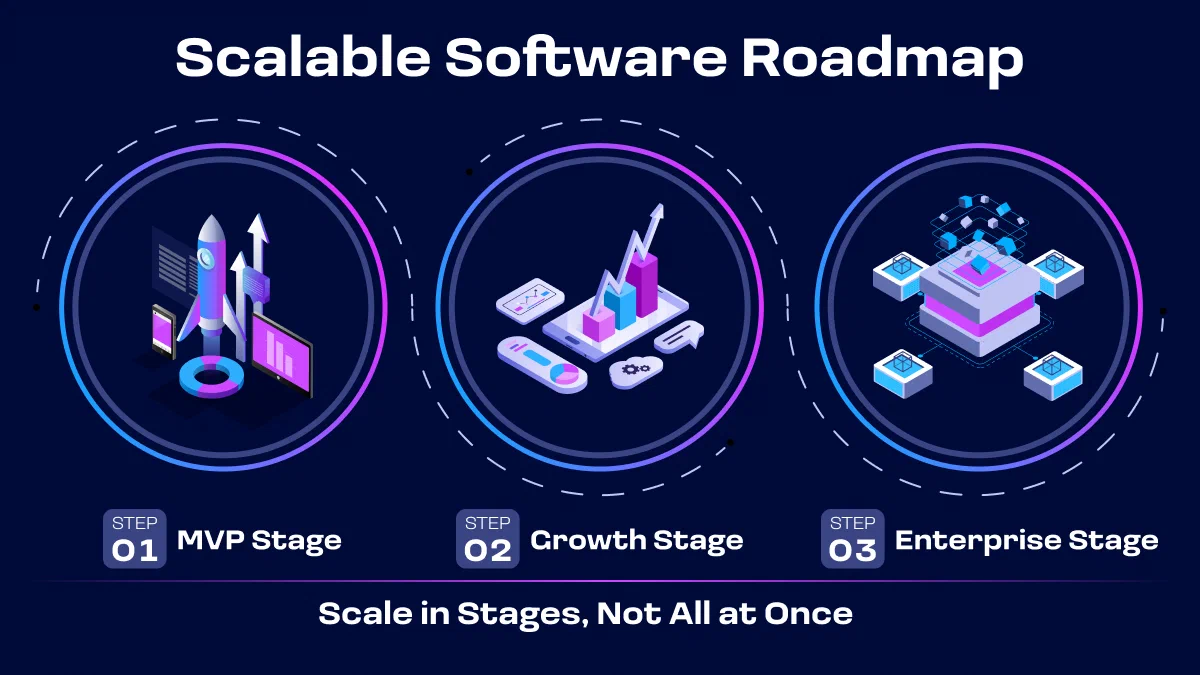
Modular monolith, single well-indexed database, containerized deployment, basic CI/CD, and lightweight error tracking (e.g., Sentry.io). Speed of iteration matters more than infrastructure sophistication.
Growth Stage (Product-Market Fit to Series B)
Read replicas and caching, auto-scaling compute, metric collection and dashboards (e.g., Prometheus and Grafana), extraction of 1 to 2 high-load modules into services if bottlenecks emerge, 70%+ test coverage on core paths.
Enterprise Stage (High Availability, Compliance, Global Scale)
Multi-region infrastructure, SOC 2/GDPR compliance program, full observability stack (including APM and distributed tracing tools like Instana), and microservices where team autonomy or scale genuinely requires it, not by default.
| Stage | User Range | Architecture Priority | Observability Tools | Key Milestone |
|---|---|---|---|---|
| MVP | 0 to 10K users | Modular monolith, single indexed database | Error tracking (e.g., Sentry.io) | Speed of iteration |
| Growth | PMF to Series B | Read replicas, caching, auto-scaling | Metrics & dashboards (e.g., Prometheus & Grafana) | First service extraction |
| Enterprise | Series C+ | Multi-region, compliance, observability | APM & tracing (e.g., Instana) | Enterprise-ready SLA |
Key Takeaways
- Software scalability is architectural and organizational, not just about handling more traffic.
- A modular monolith outperforms both an unstructured monolith and premature microservices for most startups through the growth stage.
- Database boundaries are the hardest decisions to reverse. Get them right early even while infrastructure stays simple.
- Re-architecture should be triggered by measurable signals, not a fixed timeline.
- The strangler fig pattern enables incremental migration without halting feature development.
Conclusion
Learning how to design scalable software is less about adopting enterprise infrastructure early and more about sequencing decisions correctly: modular boundaries before microservices, clean data models before sharding, observability before it’s needed in a crisis. Companies that treat scalable software architecture as a staged discipline rather than a one-time decision build systems that support growth instead of eventually blocking it.
Getting that sequencing right is exactly where most teams need outside judgment, not just documentation. If you’re weighing when to modularize, when to introduce microservices, or how to structure your data layer before it becomes a migration problem, trust!NICKOL will help on software architecture problems to scale from the first release through enterprise growth. Talk to a software architecture consultant!
Frequently Asked Questions
What is a “PMF startup”?
“PMF” stands for Product-Market Fit. A pre-PMF startup is still experimenting to find a product that a market actively wants and pays for, meaning their architecture needs to optimize for extreme flexibility and speed of iteration. A post-PMF (or Growth Stage) startup has proven their product and must shift to scaling their architecture to handle predictable growth.
Should startups build for scale from the very beginning?
No. Startups should build for 12 to 18 months of realistic growth using patterns like a modular monolith that don’t block future scaling, rather than architecting for enterprise load before product-market fit is validated.
What’s the biggest difference between startup and enterprise software architecture?
Startup architecture optimizes for iteration speed with a small team; enterprise software architecture optimizes for reliability, compliance, and multi-team autonomy at scale.
Is a monolith or microservices better for a growing company?
A modular monolith is typically the better choice through the growth stage. Microservices become justified once team size or specific bottlenecks make the added operational complexity worthwhile.
How do you know when it’s time to re-architect your system?
Watch for falling deployment frequency, concentrated incidents in one module, onboarding times over 4 to 6 weeks, and enterprise buyers raising compliance or SLA concerns.
What tools help software scale from startup to enterprise?
Containerization, managed auto-scaling infrastructure, CDN and load balancing services, CI/CD pipelines, and observability platforms form the practical toolkit across every stage. In early stages, lightweight error tracking (e.g., Sentry.io) provides maximum visibility with minimal setup overhead. During the growth stage, teams typically introduce metrics & dashboards (e.g., Prometheus & Grafana) to track resource usage and application health. As you scale to the enterprise stage, more advanced APM & distributed tracing (e.g., Instana) are introduced to handle complex distributed tracing and infrastructure-wide observability.

Alexander Nickol
Software Architect & Developer
I'm passionated about programming languages and software architecture. I can offer a great versatility of skills, entrepreneurial behavior and solution-oriented thinking in areas such as Software Architecture, Software Design and Software Development in Rust and Java.
Related Articles
Performance Engineering on Solana in 2026: Optimizing Compute, Costs, and Latency
Optimize Solana compute units, priority fees, and end-to-end latency in 2026 with practical guidance for reliable, production-grade applications.
AI-Assisted Software Development in 2026: How to Use Coding Agents Without Creating Technical Debt
Discover how coding agents are transforming software delivery in 2026, where they create the most value, and the architectural and governance guardrails needed to prevent technical debt.
When Should You Hire a Software Architecture Consultant?
Learn when to hire a software architecture consultant by recognizing the key signs of scalability issues, technical debt, performance bottlenecks, and application modernization needs.