Rust for Backend Development: Pros, Cons, and Use Cases
Discover the pros, cons, frameworks, and real-world use cases of Rust backend development. Learn when Rust is the right choice for scalable, secure, and high-performance backend systems.
Table of Contents
Introduction
Backend infrastructure has become a competitive advantage rather than a supporting component. Organizations now expect backend platforms to deliver low latency, high availability, predictable scalability, and strong security under growing workloads.
This shift has encouraged engineering leaders to evaluate programming languages beyond traditional enterprise stacks. Among them, the Rust programming language has gained significant attention for combining native performance with compile-time safety and operational reliability. It can easily be used for Rust backend development exploiting the aforementioned benefits.
Traditional backend stacks often force a compromise between execution speed and developer velocity. Rust bypasses this trade-off by combining bare-metal performance with compile-time guarantees that eliminate common runtime crashes.
This article explores the business value of Rust, examines its strengths and limitations, and identifies the backend scenarios where adopting Rust delivers the greatest return on investment.
What Is Rust Backend Development?
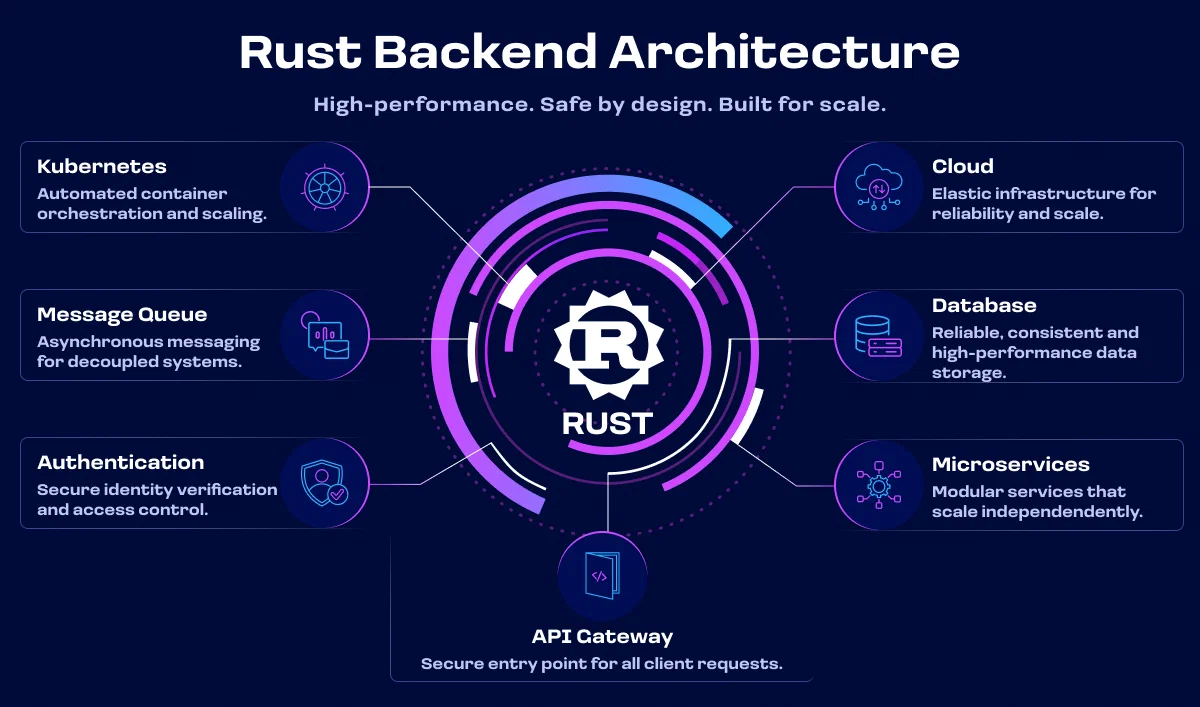
Rust backend development refers to building server-side applications, APIs, microservices, and backend infrastructure using the Rust programming language. Instead of focusing only on application speed, Rust emphasizes predictable behavior, safe concurrency, and long-term software reliability.
For organizations operating cloud-native platforms, these characteristics translate into lower operational costs, fewer production incidents, and more resilient backend architectures. This combination explains why Rust continues to gain traction among engineering teams responsible for mission-critical systems.
Understanding Rust for Web Backend
Rust was originally designed as a systems programming language, but its ecosystem has rapidly expanded into backend engineering. Today, organizations use Rust for web backend services that require high throughput, low latency, and efficient resource utilization.
Modern Rust backend frameworks such as Axum, Actix Web, and Rocket simplify API development while preserving Rust’s performance advantages. Combined with asynchronous runtimes like Tokio, they enable scalable backend services capable of supporting demanding production workloads.
Core Features That Differentiate Rust
Rust’s growing adoption is driven by three architectural capabilities: memory safety, the ownership model, and zero-cost abstractions. Together, these features eliminate entire categories of runtime failures while allowing applications to operate with native-level efficiency.
Rather than relying on garbage collection, Rust validates memory usage during compilation. This approach reduces unexpected crashes, minimizes security vulnerabilities, and provides engineering teams with stronger guarantees before software reaches production.
Core Rust Features and Their Business Impact
| Rust Capability | Technical Benefit | Business Outcome |
|---|---|---|
| Memory Safety | Prevents memory-related vulnerabilities | Lower security risk and reduced production incidents |
| Ownership Model | Compile-time validation of memory usage | Improved software reliability and maintainability |
| Zero-Cost Abstractions | High-level code without runtime overhead | Better performance with efficient infrastructure utilization |
| Safe Concurrency | Prevents data races | More reliable distributed systems and microservices |
| Native Compilation | Fast execution and low latency | Lower cloud costs and improved customer experience |
Pros of Rust Backend Development
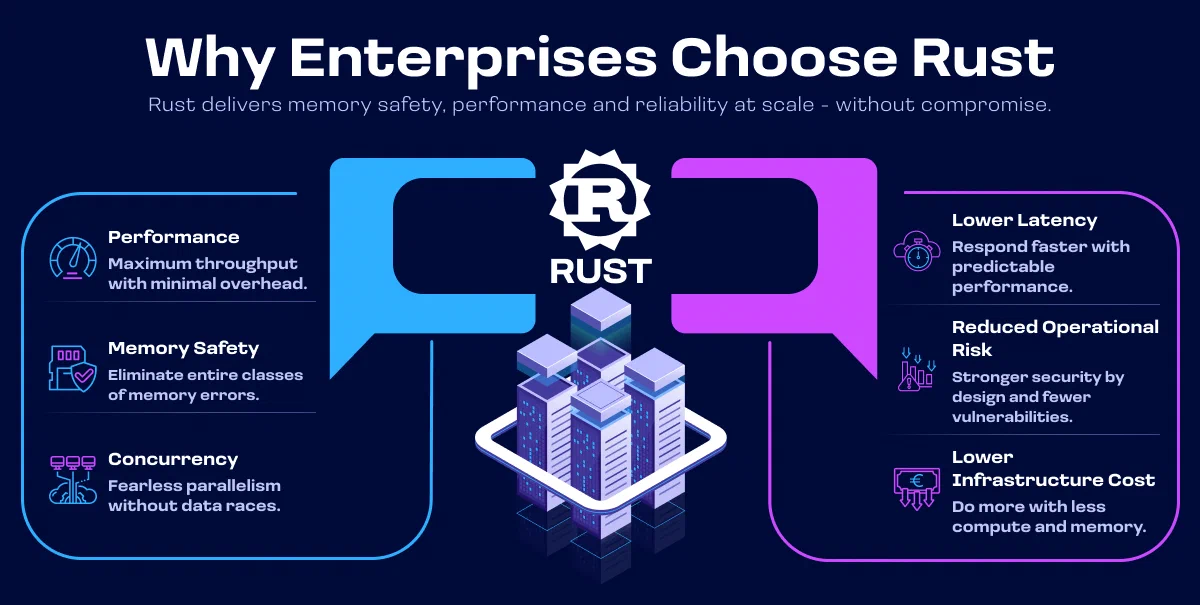
Organizations rarely adopt a new backend technology because it is technically impressive alone. They adopt it when the technology improves operational efficiency, reduces business risk, and supports long-term scalability.
This explains why rust backend development is increasingly considered for cloud platforms, backend infrastructure, and performance-sensitive services. Its advantages extend well beyond language features and directly influence engineering productivity and system reliability.
High Performance with Predictable Resource Utilization
Backend systems supporting millions of requests cannot afford unpredictable latency or excessive infrastructure costs. Rust addresses this challenge by compiling directly to native machine code, enabling consistently high throughput without a virtual machine or garbage collector.
Its zero-cost abstractions allow developers to write expressive, maintainable code without introducing additional runtime overhead. This enables engineering teams to optimize application performance while maintaining architectural clarity.
Organizations such as Discord and Cloudflare have publicly discussed using Rust to improve performance and reliability in production systems. These implementations demonstrate that efficient backend software can also remain maintainable as systems continue to grow.
Memory Safety Without Runtime Overhead
Memory-related vulnerabilities are a major source of software crashes and security breaches. Rust’s memory safety model eliminates these issues during compilation rather than after deployment. By validating ownership and borrowing rules before execution, engineering teams detect defects early and significantly reduce debugging effort.
For enterprises operating regulated or mission-critical environments, preventing these failures before release contributes to higher software quality, improved compliance, and stronger customer trust.
Safe Concurrency for Modern Backend Architectures
Modern backend platforms rely heavily on concurrent processing to support microservices, event-driven systems, and distributed workloads. However, concurrency often introduces race conditions and synchronization issues that are difficult to diagnose in production.
Rust’s ownership model enforces thread safety through compile-time guarantees. Instead of relying primarily on runtime testing, the compiler identifies unsafe concurrent operations before the application is deployed.
This approach enables backend teams to scale services confidently while reducing unexpected production failures. The result is more predictable performance under increasing workloads and greater confidence during architectural expansion.
Long-Term Maintainability and Growing Ecosystem
Enterprise software often remains in production for many years, making maintainability as important as initial development speed. Rust encourages explicit architecture and disciplined coding practices that improve readability and reduce technical debt over time.
The ecosystem has also matured rapidly. Leading Rust backend frameworks such as Axum, Actix Web, and Rocket—along with real-time bi-directional engines like Socketioxide—provide production-ready foundations for REST APIs, live event-driven communication, and cloud-native applications when paired with asynchronous runtimes like Tokio.
For organizations planning digital modernization initiatives, these capabilities position Rust as a practical choice for building reliable backend systems that can evolve alongside future business requirements.
Cons of Rust Backend Development
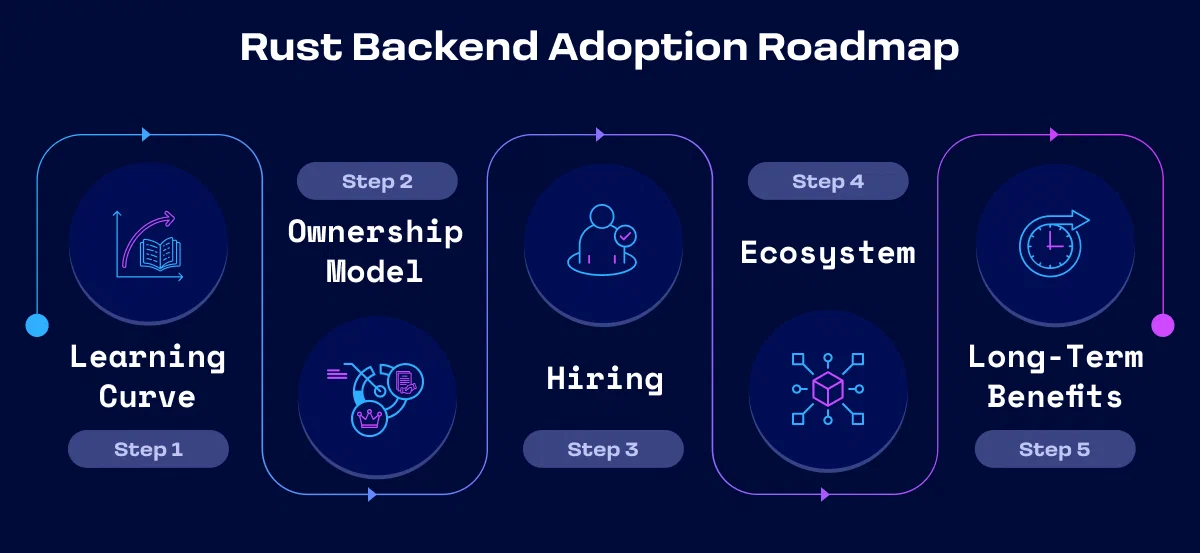
Despite its technical strengths, Rust is not the ideal choice for every backend initiative. Engineering leaders should evaluate adoption through the lens of business objectives, delivery timelines, and team capabilities rather than language popularity.
Understanding the Rust backend disadvantages helps organizations make informed architectural decisions and avoid unnecessary implementation risks.
A Steep Learning Curve for Engineering Teams
Rust introduces concepts such as the ownership model, borrowing, and lifetimes that differ significantly from traditional backend languages. While these features improve software quality, they also require developers to adopt a different way of designing and reasoning about applications.
Teams transitioning from Java, Python, or Node.js often experience slower onboarding during the early stages of adoption. Investing in structured training and coding standards can significantly shorten this learning period.
Higher Initial Development Costs
Rust’s compiler is intentionally strict because it identifies potential defects before code reaches production. Although this results in more reliable software, it can increase development time during the first iterations of a project.
For organizations delivering proofs of concept or rapid MVPs, these additional development cycles may outweigh Rust’s long-term operational benefits. Faster-to-build technologies may better align with short-term business priorities.
Smaller Talent Pool and Ecosystem
Compared with established enterprise languages, Rust has a smaller global developer community. Recruiting experienced Rust engineers can therefore take longer and may increase hiring or training costs.
The ecosystem continues to expand rapidly, but some specialized enterprise libraries and commercial integrations remain more mature in Java, .NET, or the broader JavaScript ecosystem. Technical leaders should evaluate these dependencies before selecting Rust for strategic projects.
When Rust May Not Be the Right Choice
Not every backend system requires maximum performance or compile-time guarantees. Internal business applications, simple CRUD platforms, and short-lived prototypes often prioritize rapid delivery over architectural optimization.
In these scenarios, languages with larger ecosystems and faster development workflows may provide better business value. Selecting the right technology should always reflect application complexity, operational requirements, and long-term maintenance goals rather than following industry trends alone.
Common Use Cases of Rust Backend Development
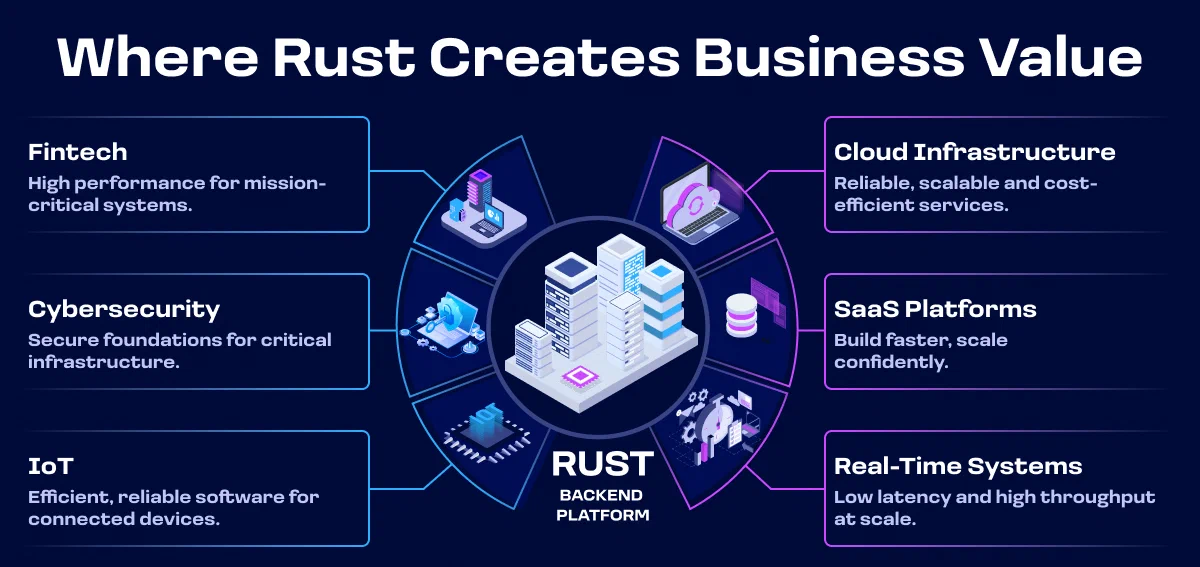
The strongest Rust backend use cases share a common requirement: they demand consistent performance, operational reliability, and strong security under sustained workloads. In these environments, reducing latency and preventing runtime failures can directly improve customer experience and lower infrastructure costs.
Rather than replacing every backend technology, Rust delivers the greatest value in systems where performance and reliability are strategic business priorities.
High-Performance APIs and Microservices
Modern enterprises increasingly rely on microservices to improve scalability and accelerate software delivery. As service counts grow, however, inefficient backend components can introduce latency, increase infrastructure costs, and complicate operations.
By compiling directly to native machine code with an exceptionally small memory footprint, Rust is uniquely suited for dense microservice meshes. Unlike JVM- or Node-based services, Rust containers start almost instantly and operate without garbage collection pauses. This allows engineering teams to deploy hundreds of microservices with minimal overhead, maintaining ultra-low latency while slashing their overall cloud container orchestration costs.
Financial Platforms and Security-Critical Applications
Financial institutions, payment providers, and cybersecurity platforms operate in environments where reliability and security are non-negotiable. Even minor software defects can result in financial loss, regulatory issues, or reputational damage.
Rust’s memory safety and compile-time guarantees reduce the likelihood of vulnerabilities commonly associated with manual memory management. These characteristics make Rust a strong candidate for payment systems, trading platforms, identity services, and other applications that process sensitive data.
Cloud Infrastructure and Distributed Systems
Cloud-native platforms require backend services that remain stable as workloads expand across multiple regions and environments. Maintaining predictable performance while controlling infrastructure costs has become a primary objective for engineering leaders.
Rust supports this objective by enabling efficient backend components with low memory consumption and excellent concurrency. Organizations including Cloudflare, Microsoft, and Amazon have incorporated Rust into parts of their infrastructure to improve reliability and strengthen performance-critical services.
Real-Time Data Processing and Edge Computing
Applications that process telemetry, streaming events, IoT data, or observability metrics require backend systems capable of handling continuous data flows with minimal latency. Delays or resource bottlenecks can reduce the effectiveness of analytics and decision-making.
Rust’s efficient execution model and zero-cost abstractions make it well suited for these performance-sensitive workloads. Whether processing event streams, powering edge services, or supporting distributed platforms, Rust enables engineering teams to deliver scalable backend infrastructure without excessive hardware requirements.
Where Rust Delivers the Greatest Business Value
| Industry | Why Rust Fits | Primary Business Benefit |
|---|---|---|
| FinTech | Secure transaction processing | Lower security and compliance risk |
| Cybersecurity | Memory-safe applications | Reduced vulnerability exposure |
| Cloud Infrastructure | Efficient backend services | Lower infrastructure costs |
| SaaS Platforms | High-performance APIs | Better scalability and uptime |
| IoT | Lightweight backend processing | Efficient resource utilization |
| Edge Computing | Low-latency execution | Faster real-time processing |
| Observability Platforms | High-throughput data ingestion | Improved system monitoring |
Is Rust the Right Choice for Your Backend Project?
Selecting a backend technology is an architectural decision that influences development velocity, operational stability, hiring strategy, and long-term maintenance. Rather than asking whether Rust is the “best” language, engineering leaders should determine whether it aligns with their technical and business objectives.
For many organizations, rust backend development delivers the greatest value when performance, reliability, and security are core business requirements rather than optional enhancements.
Choose Rust If Your Organization Prioritizes Long-Term Reliability
Rust is an excellent fit for backend platforms expected to support high traffic, strict uptime requirements, and continuous growth. Its compile-time guarantees reduce production defects, while efficient resource utilization helps control cloud infrastructure costs over time.
Consider Rust when building:
- High-performance APIs
- Cloud-native microservices
- Financial and payment platforms
- Cybersecurity solutions
- Distributed systems
- Real-time data processing platforms
- Infrastructure services
- Performance-critical backend applications
In these scenarios, the initial investment in learning Rust is often offset by lower maintenance costs, improved system stability, and fewer production incidents.
Consider Other Languages for Rapid Delivery
Not every project benefits from Rust’s architectural rigor. Teams building MVPs, internal business tools, or short-term prototypes may gain more value from ecosystems that emphasize rapid development and broader library support.
Languages such as Go, Java, Node.js, or Python may provide faster delivery when application complexity is relatively low or when existing organizational expertise favors those platforms. The most effective technology strategy is one that balances business priorities, engineering capabilities, and long-term operational goals.
Conclusion
Rust has evolved from a systems programming language into a compelling option for modern backend engineering. Its combination of memory safety, zero-cost abstractions, and a robust ownership model enables organizations to build backend systems that are secure, scalable, and operationally efficient.
Although Rust introduces a steeper learning curve and higher initial adoption costs, its long-term advantages often outweigh these challenges for performance-critical applications. Organizations evaluating Rust for web backend services should focus on business outcomes, architectural requirements, and team readiness rather than language trends.
For engineering leaders seeking predictable performance, stronger security guarantees, and sustainable backend architecture, rust backend development represents a strategic investment that can support enterprise growth well into the future.
Ready to explore what Rust could do for your backend? Let’s get in touch!
Frequently Asked Questions
Is Rust good for backend development?
Yes. Rust is well suited for backend development that requires high performance, strong security, and predictable reliability. Its compile-time guarantees help reduce runtime failures while improving long-term maintainability.
Which Rust backend framework is best?
The right Rust backend framework depends on project requirements. Axum is popular for modern asynchronous APIs, Actix Web excels in high-performance services, and Rocket offers an intuitive developer experience for structured web applications.
Is Rust better than Go for backend development?
Neither language is universally better. Rust typically offers stronger memory safety and higher performance, while Go often provides faster onboarding and simpler development for conventional backend services.
Can Rust be used for web development?
Yes. Rust web development supports REST APIs, GraphQL services, microservices, backend infrastructure, and cloud-native applications through mature frameworks such as Axum, Actix Web, and Rocket.
What are the biggest advantages of Rust backend development?
The primary Rust backend advantages include memory safety without garbage collection, high runtime performance, safe concurrency, predictable resource utilization, and excellent long-term maintainability.

Alexander Nickol
Software Architect & Developer
I'm passionated about programming languages and software architecture. I can offer a great versatility of skills, entrepreneurial behavior and solution-oriented thinking in areas such as Software Architecture, Software Design and Software Development in Rust and Java.
Related Articles
Performance Engineering on Solana in 2026: Optimizing Compute, Costs, and Latency
Optimize Solana compute units, priority fees, and end-to-end latency in 2026 with practical guidance for reliable, production-grade applications.
The Strangler Fig Pattern: Modernizing Legacy Systems Step-by-Step with Rust
Learn how the Strangler Fig pattern replaces legacy systems step-by-step with microservices, reducing the risks of complex system migrations.
Migrating C++ to Rust: Incremental Modernization Without a Full Rewrite
Learn how organizations incrementally modernize legacy C++ systems with Rust to limit risks and avoid the high costs of a complete rewrite.