Why Companies Are Choosing Rust Over C++ in 2026
Explore the Rust vs C++ debate in 2026. Learn why companies are adopting Rust for memory safety, concurrency, security, and modern systems programming projects.
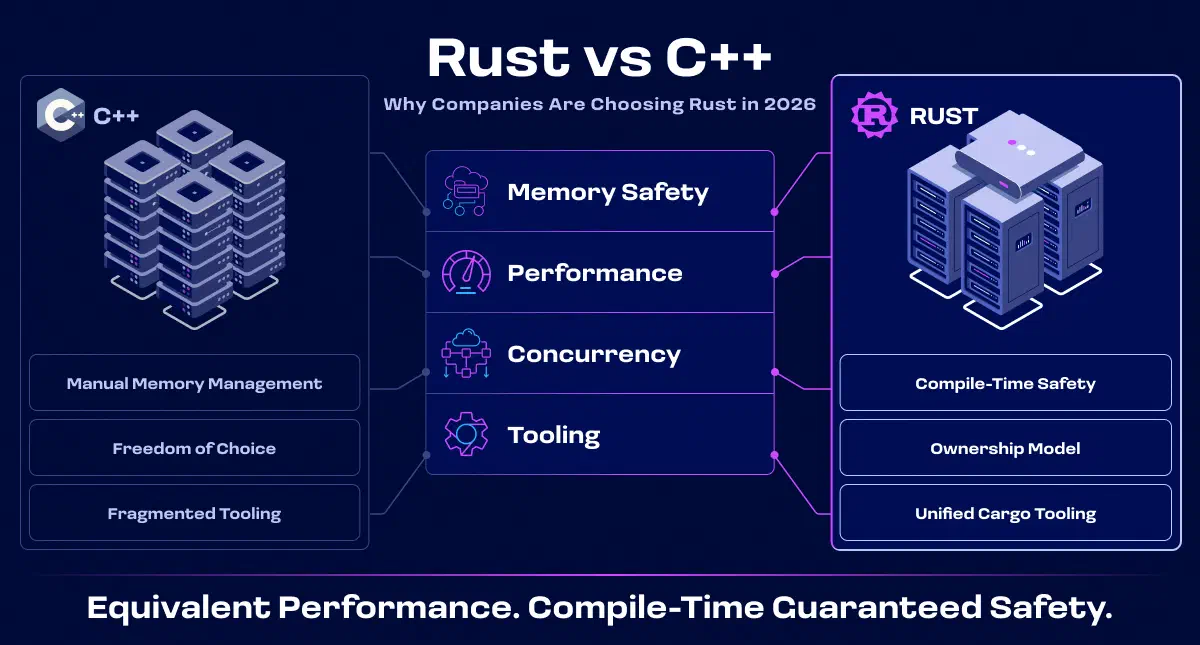
Table of Contents
C++ has powered modern computing for decades. Operating systems, databases, browsers, game engines, and embedded systems all rely on it. Its speed and low-level control made it the default choice for performance-critical software.
However, the systems programming landscape is changing. As software becomes more connected and security threats become more sophisticated, companies are reevaluating how they build critical infrastructure. That shift has pushed the Rust vs C++ debate into the spotlight.
Rust offers many of the same performance benefits as C++, but it approaches software development differently. Instead of relying on developers to avoid mistakes, Rust prevents many common errors before code ever reaches production.
The result is growing adoption across industries. Companies building cloud platforms, operating systems, networking software, and security-sensitive applications increasingly see Rust as a strategic investment rather than an experimental alternative.
Why Rust Is Gaining Momentum Across the Industry
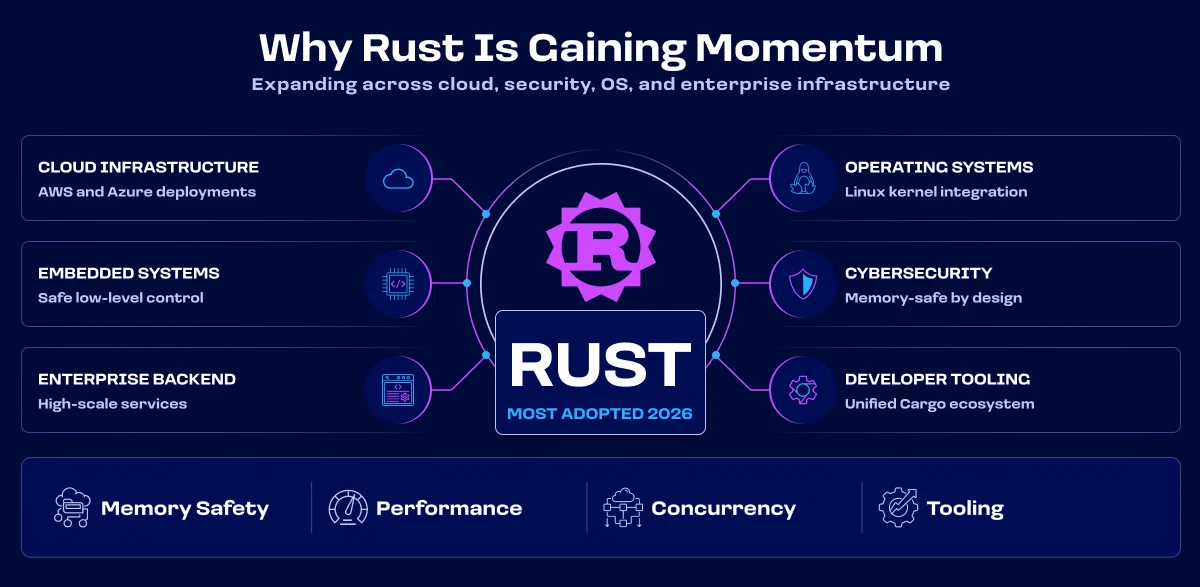
The rise of Rust is not simply a developer trend. It reflects broader changes in how organizations approach software reliability, security, and long-term maintenance.
Developer surveys consistently rank Rust among the most admired programming languages. While its overall adoption still trails established languages, enthusiasm among existing users remains remarkably high. That combination often signals a technology with strong long-term growth potential.
For businesses, the appeal goes beyond developer satisfaction. Rust addresses several challenges that have historically affected large-scale systems programming projects.
Security Has Become a Business Priority
Security vulnerabilities now carry significant financial and reputational costs. Many organizations have discovered that preventing vulnerabilities is far cheaper than responding to them after deployment.
A substantial percentage of critical software vulnerabilities can be traced to memory-related issues. These include buffer overflows, use-after-free errors, and dangling pointers.
Rust’s memory safety features were designed specifically to eliminate these categories of problems before applications reach production environments.
Rust vs C++: Different Approaches to Systems Programming
The Rust vs C++ discussion often focuses on performance. In reality, the biggest differences come from philosophy rather than speed.
C++ emphasizes flexibility and developer control. It gives programmers direct access to memory and hardware while allowing multiple approaches to solving the same problem.
Rust takes a different path. It aims to deliver similar performance while enforcing rules that reduce the likelihood of dangerous programming mistakes.
Rust vs C++: Quick Feature Comparison
| Feature | Rust | C++ |
|---|---|---|
| Memory Safety | Built into the language | Depends on developer discipline |
| Performance | Near-native performance | Industry-leading performance |
| Concurrency Safety | Compile-time guarantees | Manual synchronization required |
| Memory Management | Ownership and borrowing | Manual memory management |
| Learning Curve | Steep initially | Steep due to language complexity |
| Tooling | Unified with Cargo | More fragmented ecosystem |
| Security | Strong default protections | Additional safeguards needed |
| Legacy Ecosystem | Growing rapidly | Extremely mature |
C++ Prioritizes Freedom
C programming language or C++ programming language gives developers exceptional control over system resources. That flexibility is one reason it remains dominant in industries such as gaming, finance, and embedded systems.
The tradeoff is that safety often depends on programmer discipline. Experienced engineers can build incredibly efficient systems, but mistakes may not become visible until runtime.
Rust Prioritizes Safety by Design
The Rust programming language introduces concepts such as ownership, borrowing, and lifetimes. These rules are enforced during compilation rather than execution.
Developers may spend more time satisfying the compiler, but they often spend less time debugging memory-related issues later.
Rust Memory Safety: The Biggest Driver of Adoption
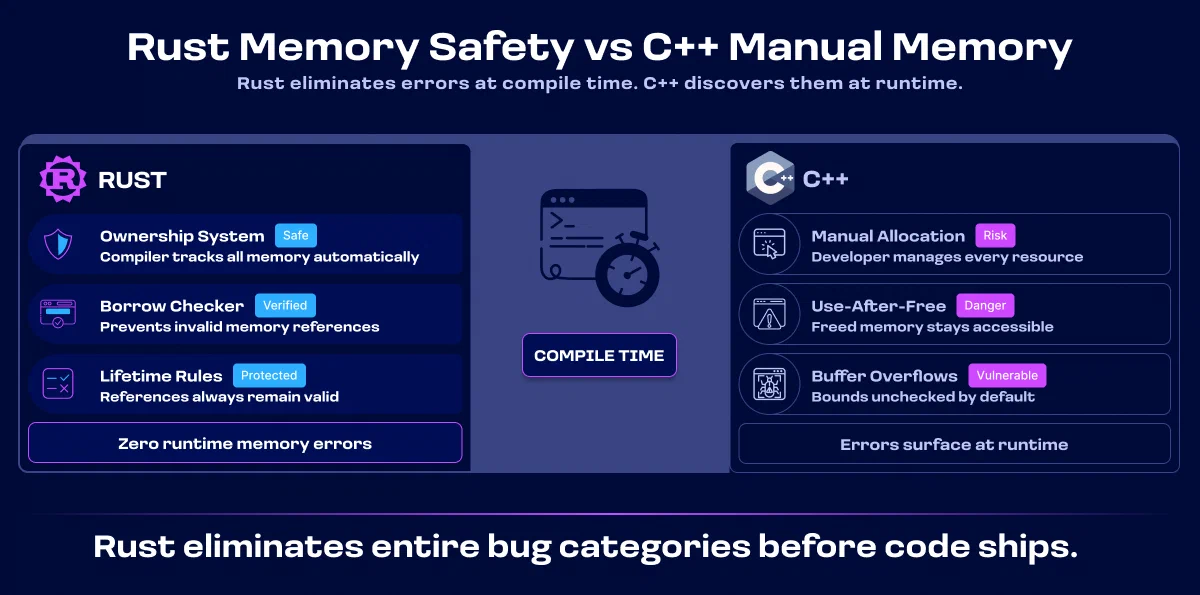
If there is one reason companies are choosing Rust over C++ in 2026, it is memory safety. Traditional systems programming relies heavily on manual memory management.
Developers must carefully allocate and release resources while ensuring references remain valid. Even experienced teams occasionally introduce subtle bugs that are difficult to detect during testing.
The Cost of Manual Memory Management
Memory-related errors can remain hidden for months. When they finally appear, they often create security vulnerabilities, crashes, or unpredictable system behavior.
For organizations operating cloud services or critical infrastructure, these failures can become extremely expensive.
Rust addresses this challenge by enforcing ownership rules at compile time. Many potential issues are caught before the software is ever deployed.
Eliminating Entire Classes of Bugs
One of Rust’s strongest advantages is that it removes entire categories of vulnerabilities rather than simply helping developers find them. The compiler prevents common issues such as use-after-free errors and many forms of data races.
This approach shifts responsibility from runtime testing to compile-time verification. That change significantly improves reliability for large-scale software projects.
Rust vs C++ Performance: Is Rust Actually Faster?
Performance remains one of the most discussed aspects of the Rust vs C++ comparison. Benchmark results often show both languages performing within a few percentage points of one another. In some tests, C++ leads.
In others, Rust performs slightly better. The overall conclusion is usually the same: performance differences are relatively small and they usually don’t matter.
Raw Benchmarks Tell Only Part of the Story
Microbenchmarks measure isolated tasks under ideal conditions. Real-world software development is far more complicated.
Applications contain multiple components, interact with networks, manage storage systems, and handle concurrent workloads. In these environments, reliability and maintainability often matter as much as raw execution speed.
Why Companies Focus on Total Performance
A system that crashes less frequently or requires fewer emergency fixes can deliver greater business value than one that performs slightly faster in benchmarks.
This is one reason many organizations view Rust vs C++ performance as effectively equal for practical decision-making. The conversation increasingly centers on productivity and security rather than benchmark results alone.
Concurrency Safety and Modern Software Development
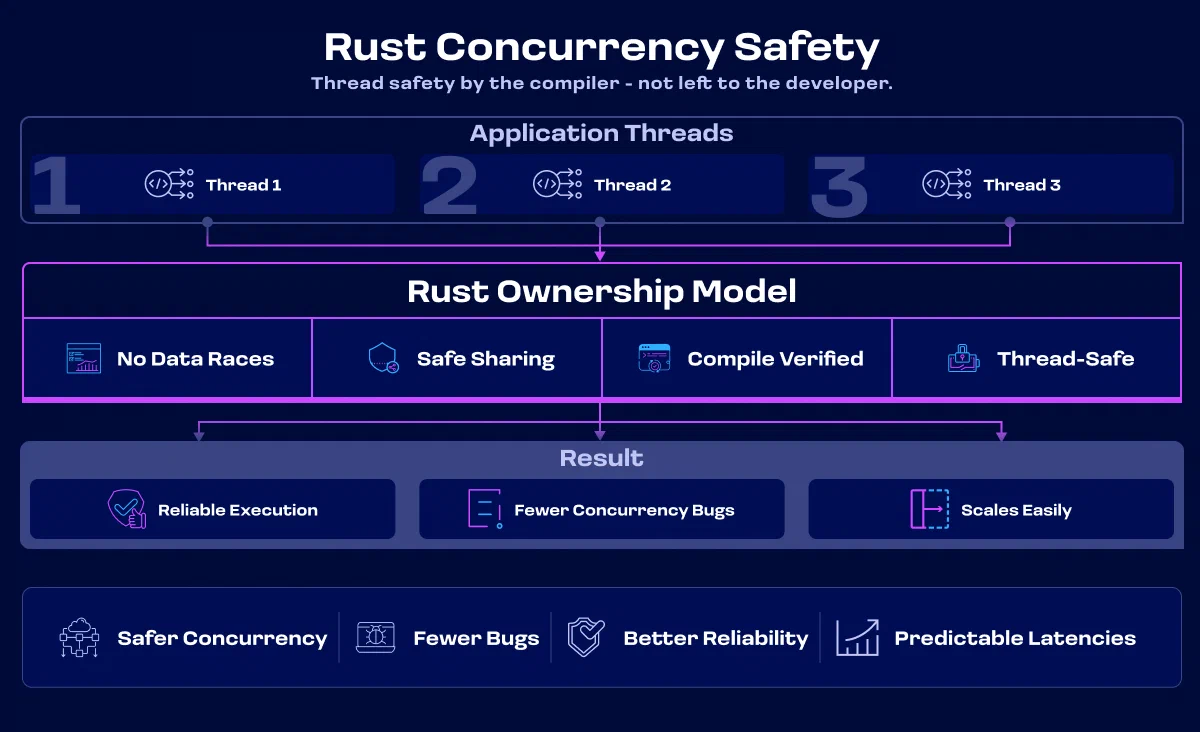
Modern software relies heavily on concurrent programming. Applications must efficiently utilize multi-core processors while handling large numbers of simultaneous tasks.
Unfortunately, concurrency introduces complexity. Data races, deadlocks, and synchronization errors can create difficult debugging challenges, especially in large codebases.
How Rust Improves Concurrency Safety
Rust’s type system and ownership model help prevent many concurrency issues before execution. The compiler enforces thread-safety requirements (such as through the Send and Sync traits) and blocks unsafe patterns unless developers explicitly acknowledge the risks.
This makes Rust particularly attractive for distributed systems, networking applications, and cloud infrastructure.
Building Reliable Multi-Core Applications
Organizations increasingly depend on software that can scale across modern hardware. Rust’s concurrency safety model helps teams build these systems with greater confidence.
Instead of discovering race conditions during production incidents, developers address them during development.
Why Major Companies Are Investing in Rust
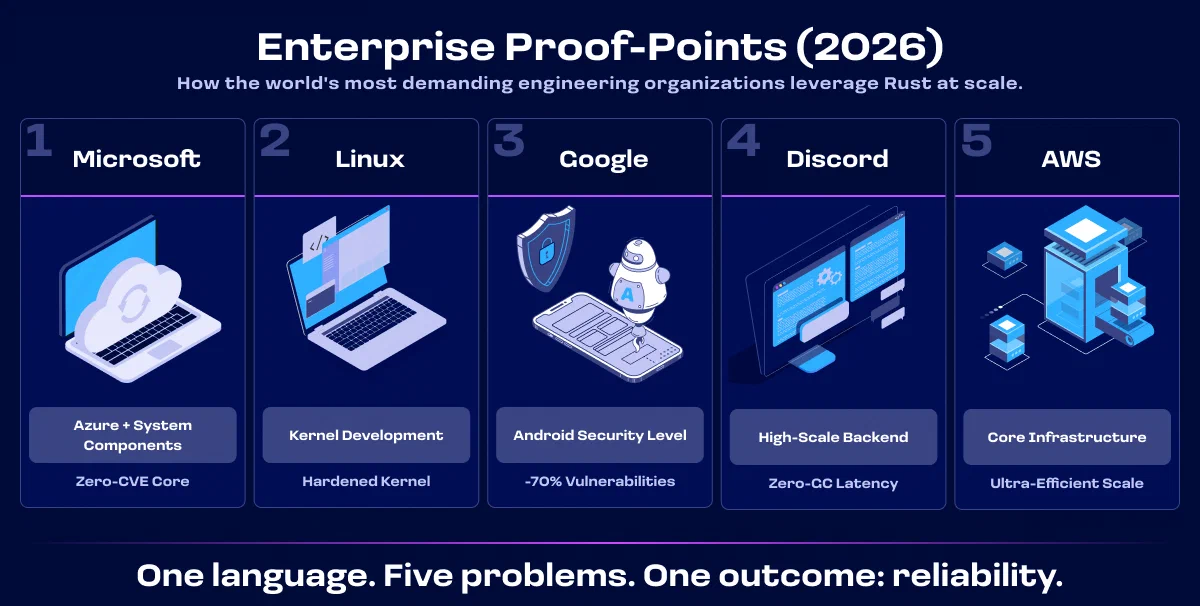
Rust’s growth is supported by more than community enthusiasm. Many large technology organizations have publicly embraced the language.
Linux developers have integrated Rust into kernel development efforts to improve safety while maintaining performance. Microsoft has expanded Rust usage across various low-level projects, including cloud infrastructure and system components. Google has also reported positive results from Rust adoption in security-sensitive environments.
Examples of Rust Adoption in Industry
| Company | Rust Adoption Area | Primary Reason |
|---|---|---|
| Microsoft | Azure, Windows system components | Security and guaranteed memory safety |
| Linux | Kernel development | Reduced memory-related bugs |
| Android operating system | Maximum security and robustness | |
| Discord | Backend services & real-time chat | Outstanding concurrency performance |
| AWS | Firecracker and infrastructure services | Maximum performance and resource efficiency |
A Long-Term Strategic Investment
These organizations are not adopting Rust because it is fashionable. They see practical benefits in reduced vulnerability risk, improved reliability, and long-term maintainability.
Their investments also strengthen the ecosystem, making Rust more attractive to other companies considering adoption.
Tooling and Developer Experience
Programming languages are only part of the equation. Development tools also influence productivity.
Historically, C++ tooling has been powerful but fragmented. Developers often choose from multiple build systems, package managers, and configuration approaches. This flexibility offers benefits but can also increase complexity.
Rust’s Unified Toolchain
Rust takes a more integrated approach. Cargo handles dependency management, package distribution, testing, and project builds through a single interface.
Integrated linters like Clippy and formatting tools like rustfmt ensure a consistent code style across the entire team without complex configuration. For many teams, this creates a smoother and more productive development experience.
When C++ Still Makes More Sense
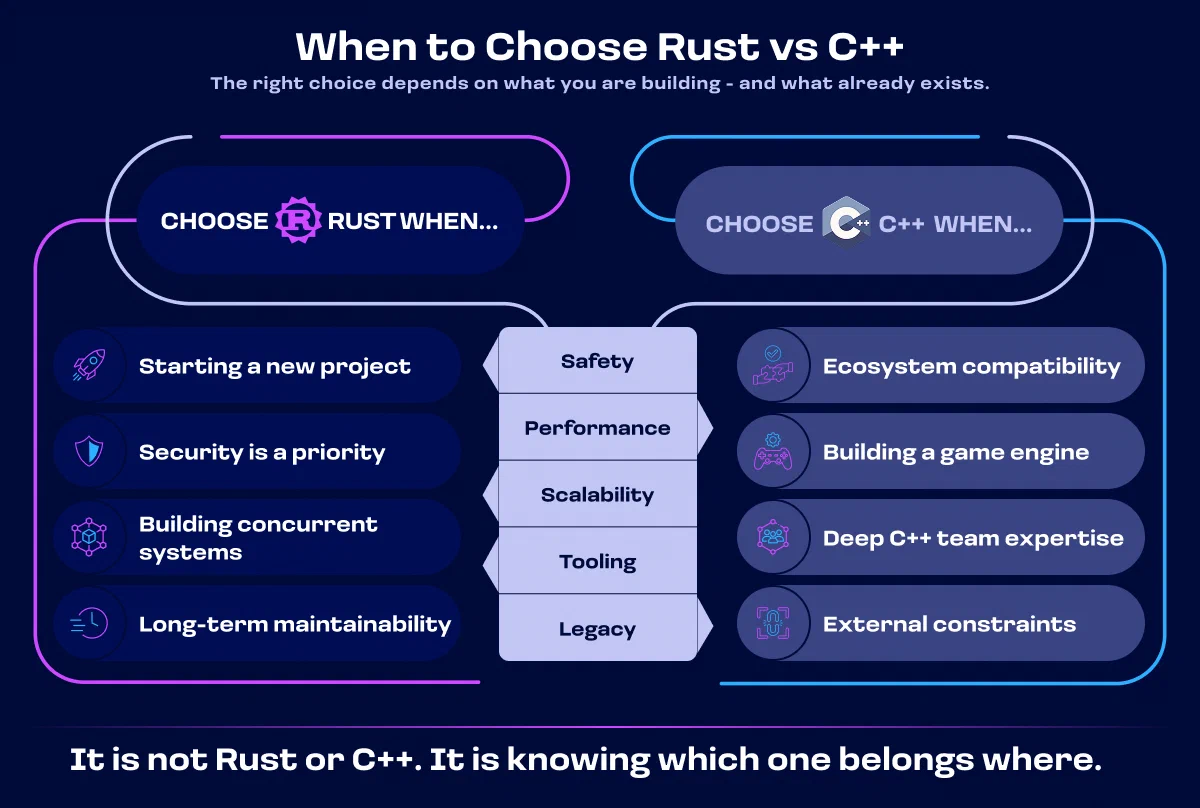
Despite Rust’s momentum, C++ remains one of the world’s most important programming languages. Large organizations maintain millions of lines of existing C++ code.
Rewriting those systems is rarely practical. Many industries also rely on mature C++ libraries and specialized tooling that have evolved over decades.
Existing Investments Matter
For established projects, continuing with C++ often makes economic sense. Experienced C++ teams can develop highly performant and secure systems when utilizing modern standards like C++20 and C++23.
The key often lies in coexistence: new, safety-critical components are written in Rust and seamlessly integrated into existing C++ systems via a Foreign Function Interface (FFI). This approach protects existing investments while taking advantage of new technologies. In many cases, the decision is not Rust or C++. It is Rust and C++ working together.
Is Rust Replacing C++?
The short answer is no. Rust is expanding rapidly, but most organizations are not replacing every C++ system.
Instead, they are evaluating Rust for new projects where security and maintainability are high priorities. This approach allows teams to gain Rust’s benefits without disrupting critical existing infrastructure.
A Future With Both Languages
The future of systems programming is likely to include both languages. C++ remains essential for many performance-critical environments and legacy systems.
Rust continues gaining traction in new development where memory safety, concurrency safety, and long-term reliability are priorities.
Rather than replacing C++, Rust is becoming another powerful tool available to modern engineering teams.
Conclusion
The Rust vs C++ debate has evolved beyond simple performance comparisons. Companies are increasingly choosing Rust because it addresses challenges that have become more important in modern software development.
Rust’s memory safety features reduce vulnerabilities. Its concurrency safety model improves reliability. Its tooling simplifies development workflows.
C++ remains a powerful systems programming language with an enormous ecosystem and decades of proven success. However, for many new projects in 2026, organizations view Rust as a compelling alternative.
Rather than the end of C++, this shift represents a professionalization of systems development. The future points to a coexistence where both languages play important roles in building secure, high-performance software. If your organization is facing the question of how to future-proof your software landscape, modernize legacy systems, or implement new projects, trust!NICKOL can support you with independent consulting and deep Rust expertise.
FAQs
Why are companies choosing Rust over C++ in 2026?
Companies are increasingly choosing Rust because it combines high performance with built-in memory safety. Rust helps prevent common vulnerabilities such as buffer overflows, use-after-free errors, and data races before software reaches production.
Is Rust faster than C++?
Rust and C++ deliver very similar performance in most real-world applications. While C++ may outperform Rust in certain microbenchmarks, the difference is usually small. For many organizations, reliability and maintainability are more important than minor performance variations.
What makes Rust memory safe?
Rust uses an ownership, borrowing, and lifetime system that enforces memory safety at compile time. This approach eliminates many common memory-related bugs without relying on a garbage collector.
Can Rust completely replace C++?
Not entirely. C++ remains deeply embedded in operating systems, game engines, embedded devices, and enterprise software. Most organizations use Rust for new projects while continuing to maintain existing C++ codebases.
Why is Rust popular for concurrent programming?
Rust’s type system prevents many concurrency issues before code runs. The compiler detects unsafe access patterns and data races during development, making it easier to build reliable multi-threaded applications.
Which companies are using Rust in production?
Several major technology companies use Rust in production environments. Organizations such as Microsoft, Google, Linux kernel contributors, AWS, and Discord have adopted Rust for various systems programming and infrastructure projects.
Is Rust difficult to learn for C++ developers?
Rust has a learning curve because of concepts like ownership, borrowing, and lifetimes. However, developers with C++ experience often adapt more quickly because they already understand memory management and low-level programming concepts.
Should I learn Rust or C++ in 2026?
The best choice depends on your goals. C++ remains essential for many industries and legacy systems. Rust is growing rapidly in security-focused and infrastructure-related development. Learning both languages provides the strongest foundation for modern systems programming careers.

Alexander Nickol
Software Architect & Developer
I'm passionated about programming languages and software architecture. I can offer a great versatility of skills, entrepreneurial behavior and solution-oriented thinking in areas such as Software Architecture, Software Design and Software Development in Rust and Java.
Related Articles
Performance Engineering on Solana in 2026: Optimizing Compute, Costs, and Latency
Optimize Solana compute units, priority fees, and end-to-end latency in 2026 with practical guidance for reliable, production-grade applications.
The Strangler Fig Pattern: Modernizing Legacy Systems Step-by-Step with Rust
Learn how the Strangler Fig pattern replaces legacy systems step-by-step with microservices, reducing the risks of complex system migrations.
Migrating C++ to Rust: Incremental Modernization Without a Full Rewrite
Learn how organizations incrementally modernize legacy C++ systems with Rust to limit risks and avoid the high costs of a complete rewrite.